
Mural Art for War Remnant Awareness on Gaza's Rubble
Gaza ramps up awareness of war remnants through murals and sessions to shield women and children from unexploded ordnance amid rising casualties.
RAFIF ISLEIM
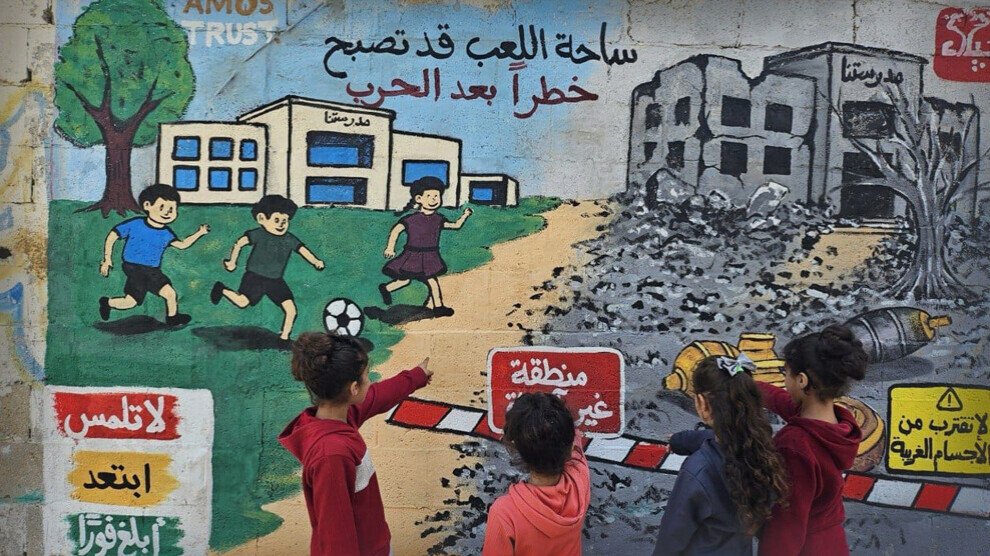
Gaza — After three consecutive years of war on the Gaza Strip and the intensification of Israeli ground operations, neighborhoods, destroyed homes, alleys, and tents are rarely free of war remnants. Therefore, the Ajyal Foundation for Creativity and Development has produced awareness murals to alert women and children to the danger of touching unexploded ordnance through simple visual messages and short phrases adorning Gaza's rubble with color.
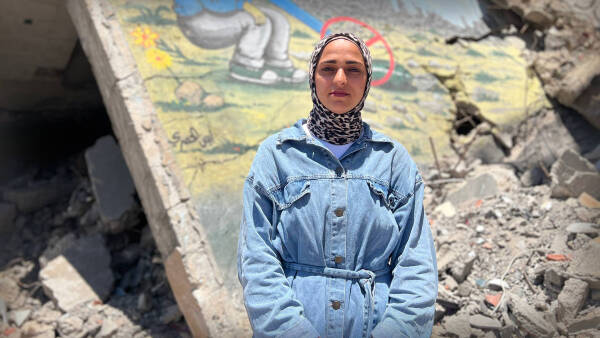
Sara Muhsin, facilitator of sessions at the Ajyal Foundation for Creativity and Development, said that the murals are part of an awareness project aimed at warning of the danger of war remnants and explosive ordnance, as the Gaza Strip is an open arena for aerial and ground attacks, especially given the weight of what it has endured and the quantity of ordnance—considered the largest proportion of war remnants in the world, according to international reports.
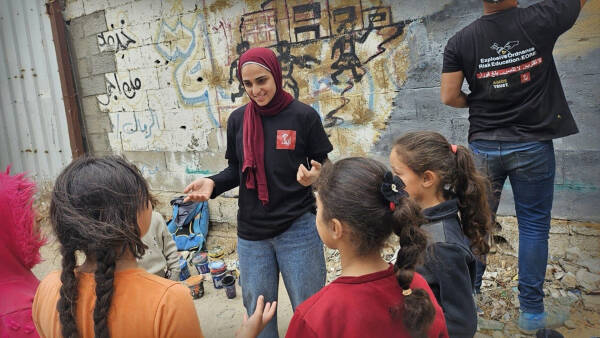
She added that between 10 and 30 percent of that ordnance has not yet detonated, posing a great danger to children in society amid a lack of awareness on how to deal with such remnants, coupled with their curiosity and desire to play—especially in areas previously bombed and among building rubble. She noted that since the beginning of 2025–2026, approximately 306 incidents have been recorded as a result of tampering with such remnants, resulting in 859 victims, including 709 injuries ranging from minor to moderate, and 150 deaths—among them children, women, and men.
These alarming figures prompted the foundation to act and paint murals in every location with high population density, according to Sara Muhsin. Work was carried out in camps, residential neighborhoods, and even near danger zones. She noted that it is important to paint the murals alongside awareness sessions and videos published on social media, which received interaction and response through knowledge of safe places and the adoption of behaviors that protect individuals when encountering a foreign object.
She hopes that this awareness will reflect on the numbers and rates of deaths and injuries, reducing the recorded statistics among Gaza's population to a reasonable and manageable level. She said: "I constantly emphasize to children several phrases: anything that has not fallen from your hands, or that you do not know, or that you have seen from a distance—you cannot touch or approach it to avoid the danger of a timed explosion that could lead to death or loss of the body's ability to perform vital functions."
Diverse Themes for the Murals
She added that the murals addressed various themes. One painting shows a child being prevented from touching a suspicious object encountered on his way. Another depicts a comparison between the play areas where children spent most of their time before and after the war on Gaza, and how the school, the park, or even the home—once bombed—has become a place dangerous to children's lives. She explained that even mechanisms for dealing with war remnants were depicted in a complete mural with detailed steps.
The murals covered Unity Street, Al-Jalaa Street, Al-Saraya Street, Tal Al-Hawa, and other areas through which thousands of citizens pass daily. She noted that what helped the idea succeed was painting the murals in bright and distinctive colors. From among the grey, these colors shine from afar, drawing passersby to inspect the mural and understand its message. Some children even invite each other to view it—whether during or after the painting process—and discuss their own experiences.
Recently, with the growing number of workshops she conducts for children and women, she has noticed an increasing need for awareness and education, with mothers requesting that their children attend the sessions. She explained that she aspires to deliver her message to areas near the Yellow Line, such as Beit Lahia, where the rubble amounts to ticking bombs that could explode at any moment—necessitating awareness first and foremost from families and teachers, with institutions and other bodies playing a subsequent role.