
Morocco… The Najda Center, a Refuge for Women Survivors of Violence
The Najda Center in Marrakech, affiliated with the Union of Feminist Action, provides legal and psychological support to women survivors of violence, sheltering dozens who confront hardship to defend their rights and preserve their dignity.
Raja Khairat
Morocco – At a time when many women victims of violence choose silence under family and societal pressure, others prefer to break that silence and turn to listening centers run by associations concerned with abused women, seeking protection and safety, as well as to claim their rights and defend their dignity.
According to figures issued by the High Commission for Planning, among 13.4 million women and girls aged between 15 and 74, 82.6% have been subjected to at least one form of violence during their lives, whether physical, economic, sexual, or psychological. However, only 10.4% of women victims of violence take legal action or file complaints with the competent authorities, and the percentage does not exceed 3% in cases of sexual violence. Consequently, many cases remain unreported.
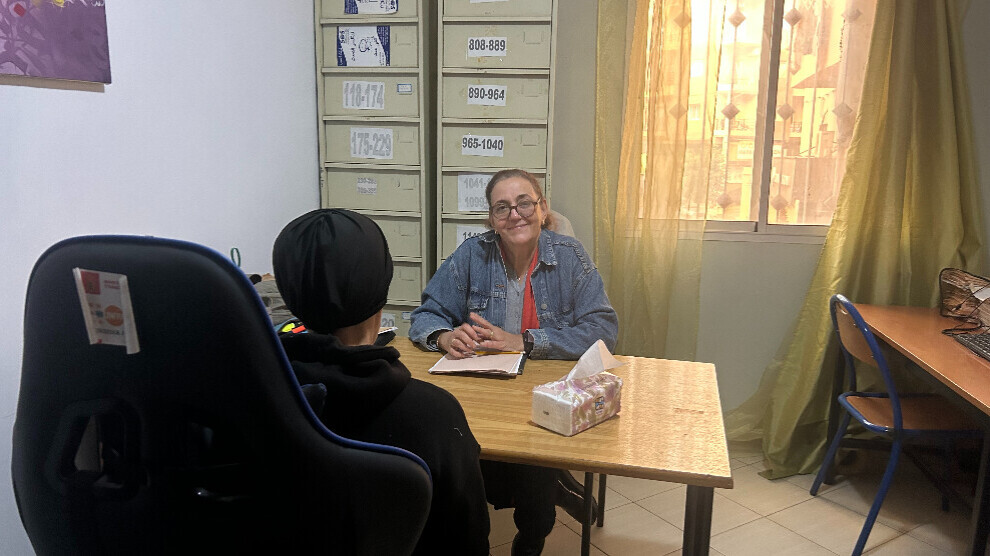
The Najda Center for Assisting Women Victims of Violence receives survivors on a daily basis, listening to them and guiding them according to their needs through a series of legal procedures on their journey to claim their human rights.
Two Wives Sharing One Room
“S. A.” turned to the Najda Center for women victims of violence in Marrakech, dragging with her deep disappointment from a marriage that lasted only a few months, after she was forced to share the same room with a second wife under inhumane conditions.
At the age of nineteen, she reluctantly agreed—under family pressure—to become a second wife. She never imagined herself married to a man thirty years older than her. She says, “I could not refuse under my father’s pressure; he was his friend. Despite the huge age difference, I accepted. But the shock I never expected was that he lived with his first wife in a house consisting of a single large room, which he divided with a curtain placed in the middle to separate the two spaces.”
She insisted on divorce despite her husband’s and his family’s refusal, resorted to the courts, and waived her rights in exchange for freedom from a humiliating marriage. Left without a provider, she was forced to work as a waitress, believing that preserving her dignity was far less harmful than continuing that life.
Early Forced Marriage and Violence
The situation of “F. N.” is no different from that of other abused women who sought refuge at the Najda Center, where they found psychological and legal support and accompaniment. She says, “I was forced to drop out of school and marry early by my family, who convinced me that marriage was better than education, and that the earlier the marriage, the better it was for a girl.”
Despite her academic excellence, she was persuaded and moved to live with her husband’s family in a city far from Marrakech. She adds, “From the very first day, I realized that my life would be a series of episodes of physical and psychological torture, and my intuition was correct. Within a few days, I found myself a servant in my husband’s family home. I woke up early every morning and spent my day doing endless hard labor, accompanied by humiliation and beating, until I decided to end my journey of suffering and escape with the help of a neighbor. But my disappointment was great when my family abandoned me and my father asked me to return to the marital home.”
Limited Shelter Centers and Lack of Funding
Amina Bayan, an administrator at the Najda Center for Assisting Women Victims of Violence, explained that the Union of Feminist Action considers combating violence one of the core missions of its struggle for equality and against discrimination against women.
She noted that the Najda Center plays an important role as a militant mechanism to protect women, by providing services that include follow-up, legal and psychological support, accompaniment, and economic empowerment.
Regarding the reception of women victims of violence, she said that since its establishment the center has worked to receive women subjected to various forms of violence, including physical and psychological violence. She pointed to the scarcity of shelter centers, saying, “There is a very limited number of shelters, and they suffer from a lack of funding. It is not possible to open shelters without financial resources. As a result, abused women may find themselves on the streets if their families refuse to take them in and support them.”
She stressed that violence in Morocco requires an integrated legal and social response. “Najda Centers operate according to clear mechanisms, such as reception and listening within a safe space, in addition to assessing risk levels, providing psychological and legal support, and accompanying the concerned woman through all stages of claiming her rights.”
Legal Shortcomings
Amina Bayan emphasized the urgent need for laws that protect women from violence and take into account their social circumstances. She pointed out that Law 103-13, issued to protect abused women, although an important step, suffers from several shortcomings. Among them is the requirement that the woman victim of violence prove the abuse—which often occurs inside the marital home—and bring eyewitnesses, in addition to the lengthy and complex procedures and the absence of urgent measures to protect the victim during the first hours after reporting. As a result, women remain at risk despite the existence of a law that is supposed to provide protection.
She added that the law does not adopt a broad definition to include institutional violence and economic violence in a precise manner, nor does it recognize marital rape. She also pointed to the weakness of resources and grants allocated to relevant associations, as well as the shortage of qualified human resources.
She explained that changing laws alone is not sufficient without working to change mindsets and eliminate the patriarchal mentality that still forces women to remain submissive to their husbands. She affirmed, “Mountains can be moved from their place, but changing the patriarchal mentality requires a great deal of effort and work, through spreading awareness of human rights culture and enshrining the principle of equality in school curricula among students.”
She called for the establishment of a unified national database among various stakeholders such as the police, gendarmerie, hospitals, and the judicial system (courts), as well as simplifying procedures. She also warned of one of the most dangerous forms of violence that has been spreading rapidly in recent times: digital violence, due to the tragic consequences it produces, such as victims’ suicide because of the stigma that follows them. This field is constantly evolving, as some husbands resort to imposing strict surveillance through applications that allow them to monitor their wives on social media, in a blatant violation of users’ privacy.
Amina Bayan stressed the importance of protecting underage girls from predators and harassers online, where they are lured and blackmailed. She also called for adopting a gender-sensitive approach within the justice system, noting that the prevailing culture among some judges still reflects stereotypical rulings that harm victims