
Long Distances and Long Waits... The Journey of Fetching Water Weighs Heavily on Women in Yemen
In Yemeni villages, the journey of obtaining water has become a daily burden shouldered primarily by women and girls, amid arduous distances and long waits, threatening their health and limiting their opportunities for education, work, and a safe life.
RAHMA SHANZOUR
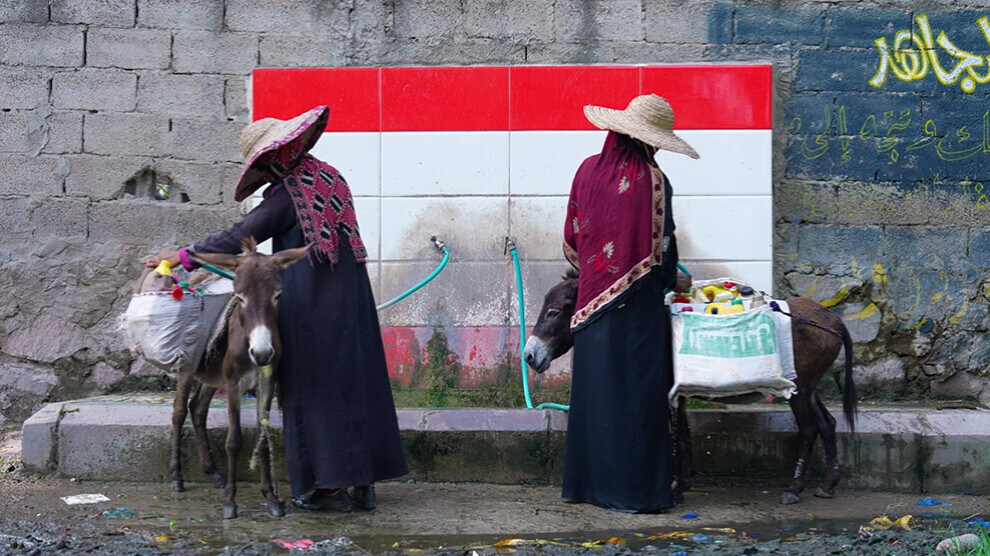
Yemen — Between a rugged road that Samira Ali traverses three times a day to fetch water, and a school that Amal Khaled left after the search for water became part of her responsibilities, the suffering of women and girls in rural Yemen is embodied. Water scarcity not only burdens them with providing for their families' needs but also takes hours from their day and leaves lasting effects on their health, education, and daily lives.
Every morning, Samira Ali, 33, sets out on her daily journey to fetch water, carrying on her head a traditional vessel known in Yemen as a "Dabbah," which she uses to transport water from the Al-Sayahi spring to her home in the village of Al-Maqfayah.
For the past ten years, Samira Ali, like many other women in Yemen, has grown accustomed to traversing the road in search of water. However, the ruggedness of the road makes the short distance seem longer than it is, as she walks about one kilometer each way, three times a day, carrying around 20 liters of water each time to secure her family's needs and continue her household chores.
She says: "Every day I go out to the water spring, I walk three times a day. The road is tiring and rugged. Yet we have no other choice; we are forced to go fetch water, and then I return to complete my housework." The task does not end upon reaching the spring; Samira Ali sometimes has to wait to get water, especially when the source is crowded with residents.
She explains: "Years have passed like this; we have grown accustomed to the hardship. Sometimes we wait for hours at the spring until we get water." She hopes that a water project will reach her village, alleviating the hardship of the daily journeys for her and the village women, giving them more time for their families and work.
Samira Ali's daily journey to fetch water reflects a reality experienced by women and girls in many rural areas of Yemen, where they bear a large share of the responsibility of providing water for their families.
Education Pays Part of the Price
The effects of the water crisis are not limited to women who bear the responsibility of fetching it, but extend to girls as well. The longer the distance and time required to reach water sources, the more their chances of regular schooling decline, as some are forced to miss school or drop out of education to help their families secure water.
Amal Khaled, 18, is one of the girls who stopped her education and became occupied with fetching water and shouldering family responsibilities. She says: "The time we should be at school, we go to the water spring, and so the time passes while we are still at the spring." She added: "War and all the crises were the cause of this. Our situation is difficult, both health‑wise and education‑wise."
Women's Health Under the Strain of Carrying Water
The impact of fetching water does not stop at depriving some girls of education; it extends to women's and girls' health, as they are forced to carry water vessels over long distances and repeat this daily.
In areas that rely on unsafe water sources, health risks multiply. Contaminated water, along with the difficulty of transporting and storing it safely, may increase the likelihood of water‑related diseases and hygiene issues.
Amal Khaled says: "Carrying water is very tiring. We walk long distances and carry the Dabbah, and sometimes we feel back and body pain from the weight and the repeated trips." She added: "We return from fetching water exhausted, and afterward there is no time to rest; we continue with housework and our responsibilities."
A Chronic Crisis
This suffering comes within the context of a chronic water crisis in Yemen, which is among the countries most affected by water scarcity in the world. According to UN data, the per capita share of renewable water resources does not exceed 80 cubic meters annually, compared to 1,000 cubic meters, which is the global threshold for water stress.
Several factors intertwine in exacerbating the crisis, most notably the absence of permanent rivers, reliance on rainwater and groundwater, which are depleting due to increasing demand.
More than 14.5 million people in Yemen lack access to safe drinking water and sanitation services, with most concentrated in rural and hard‑to‑reach areas. The repercussions of water scarcity are not limited to households but extend to agriculture in areas that depend on local water sources, where crops such as coffee and vegetables are affected, and some families' ability to maintain their sources of income declines.
Amid conflict, poverty, and water scarcity, the journey of searching for water continues day after day, while women and girls remain at the forefront of those bearing the cost of a crisis that is not only about water, but about their right to time, health, education, work, and a safer life.