
Despite Displacement at Ninety, She Preserves Her Embroidered Thobes from 77 Years Ago
Fatima Abu Funun's story spans two displacements and two sorrows, carrying Qatra's memory and resisting oblivion with an ageless yearning to return.
RAFIF ISLEM
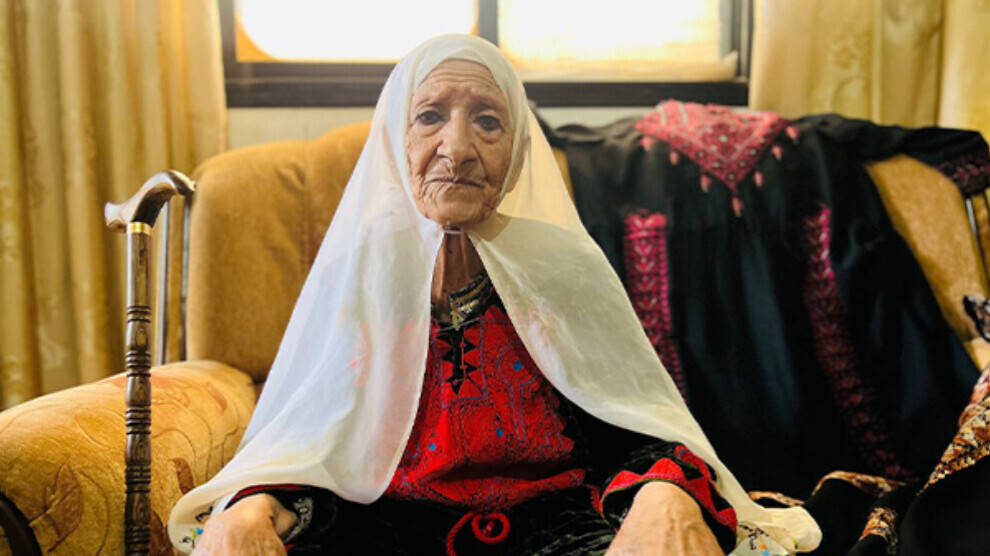
Gaza — Palestinian woman Fatima Abu Funun still preserves the embroidered thobes she brought with her when she was forcibly displaced from the village of Qatra, located southwest of the Ramle sub-district in central Palestine. These garments bear witness to the history of a land and the events experienced by Palestinian women before the Nakba of 1948. Through recounting their stories to her children and grandchildren, she continues to guard those details in her memory.
Fatima Abu Funun left the village of Qatra when she was no more than fifteen years old—perhaps slightly older or younger. Like other daughters of rural villages, her family did not concern themselves with teaching her to read or write, nor did she ask about her age. All she remembers is that on a harsh day filled with the buzz of gunfire, her mother took her and her siblings by the hand, and they hurried out of the village alongside her father and brothers. That was the last time she ever saw Qatra.
The ninety-year-old Fatima Abu Funun recounts that this scene was revisited in her memory when Israeli forces issued an evacuation order for the Nuseirat Camp in the southern Gaza Strip during the October 2023 war. There were no new details to speak of: residents were given just one hour to vacate the camp entirely, as gunfire and bombardment surrounded them from every direction. She wept for fear that the fate of Qatra would repeat itself, and that she might never return to the home she had built stone by stone. She explains that today she is grateful to be back in her home among her children and grandchildren.
Customs and Traditions
Turning back to the village of Qatra, she tells us that life there was pleasant and beautiful, yet the education of girls was considered a transgression. In contrast, when the residents were displaced to the Gaza Strip, everyone began enrolling their daughters in schools, institutes, and universities. What they had once deemed a crime worthy of punishment became as if it had never been an issue. She notes that "the young men and sons of Qatra all received an education, and after school, they were even sent to major universities in neighboring Arab countries."
She adds that women in Qatra would wake early in the morning to finish their chores, then head to the field or to tend livestock. All the families in that town owned land, and women would go there either for work or to enjoy an outing with the children. She notes that they were constantly inventing new embroidery designs because they practiced this art throughout the day and taught it to women from other villages.
According to Fatima Abu Funun, Qatra had its own distinct traditions. Only married women wore a fully embroidered thobe, while young girls wore dresses made of cotton or linen that had no embroidery or only light embellishments on the sleeves. These were accompanied by a white head covering called the bashnīqa (a traditional veil) and jewelry consisting of gold liras arranged side by side in particular designs.
She emphasizes that what she longs for most are the weddings in Qatra, which would last an entire week. Girls would prepare and gather daily at the bride's home to sing folk songs and chants, while the men of the family would slaughter livestock to feed the attendees, whether from the village itself or from neighboring villages. The bride would wear several different thobes in various colors and embroideries, along with a head veil made of gold liras, making her stand out among the gathering.
"Longing Works Miracles"
She brought with her from Qatra twenty embroidered thobes made of different fabrics and colors—the result of a trousseau that her mother had prepared for her, which she refused to leave behind during the displacement. She explains that some of these thobes clearly show signs of wear, but she refuses to part with them. She has given away others to her daughters, so that they too may carry a part of the village’s memory and bounty, which she never ceases to speak of day and night.
Fatima Abu Funun dreams of returning to her village. When we asked her how that would be possible, she smiled and said she would run on the very feet that can no longer move today—because longing for Qatra alone is capable of working miracles. She advises Palestinians not to leave their lands and emigrate, no matter how difficult the circumstances. After 77 years, she still remembers the finest details of days that have become part of a distant memory, and she dreams of spending just one day on her land before she departs from this life.