
"Bus of Dreams" Initiative to Address the Psychological Effects of War on Palestinian Children
The Bus of Dreams launched for the first time in 2024 in Gaza City and continues to this day, touring the governorates of the city except for some due to security dangers.
RAFIF ESLIM
Palestine – The Palestinian Red Crescent Society transformed one of its ambulance vehicles from a means of transporting the wounded and injured into a mobile cinema for children touring the camps and educational points in the Gaza Strip, after the absence of entertainment tools for nearly three years, calling it the "Bus of Dreams," which has become famous among children in all governorates of the Strip.
The "Bus of Dreams" initiative, launched by the Palestinian Red Crescent Society, is considered one of the most prominent innovative humanitarian ideas to confront the harsh psychological effects of war on children in the Gaza Strip.
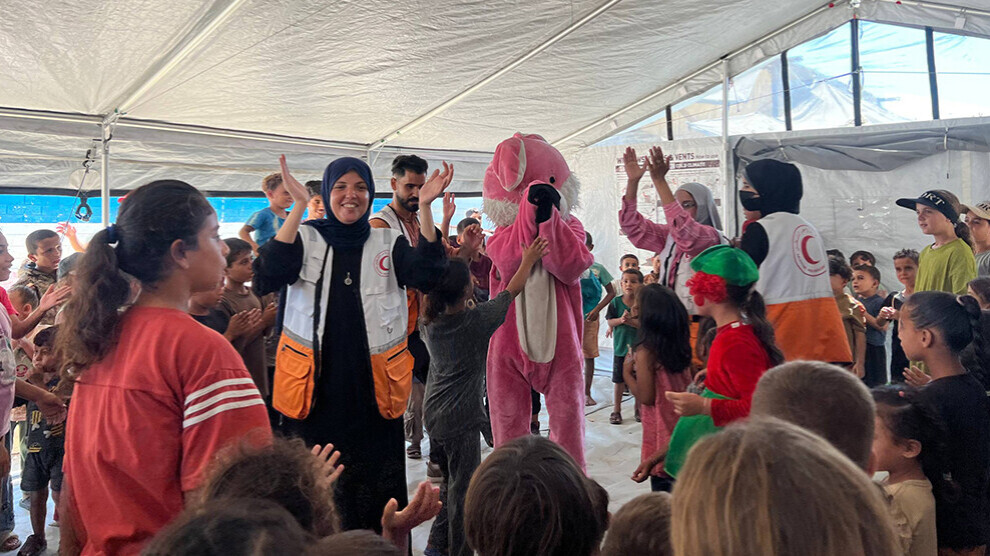
The director of the Mental Health Department at the Palestinian Red Crescent Society, Niveen Abdel Hadi, said about this initiative that it is an entertainment initiative by the Society that was created to tour the camps of the Gaza Strip and educational points, with the aim of drawing smiles on children's faces amid the difficult situation they have been living for three years until today.
The Bus of Dreams launched for the first time in 2024, and continues today in both the city and southern governorates, but it has not yet reached the north due to "the danger there, despite continuous attempts to reach the governorates of Beit Lahia and Jabalia."
Entertainment... A Right of Children
The power outage since the beginning of the war until today has made it difficult for parents to provide television viewing, so children today are eager to sit in front of a screen and watch what is shown to them. Niveen Abdel Hadi also says that watching cartoons is "a right of children," so the initiative tries to provide it for them with several corners dedicated to play, including "the storyteller, which focuses on the psychological and educational aspect through presenting the story and spreading values, another corner for movement and sports, and a third specialized in popular games made from recycled materials through what is available, such as cloth dolls, especially amid the crazy prices of children's toys recently."
She explains that Gaza's children "do not live a natural life like the rest of the world's children," as their schools are shelters for the displaced and their time passes between fetching water after chasing trucks, and bringing food after standing in lines that distribute food for free to the displaced. She indicated that the Bus of Dreams is "an attempt to provide joy and psychological support for them," even for a short time, to compensate them for the difficulties they experience.
Among the difficulties facing the Bus of Dreams, according to Niveen Abdel Hadi, is the difficulty of movement and its expenses. "The bus tours a long distance, in addition to the unavailability of the necessary and appropriate tools to implement activities or to expand some of them and introduce new events." She explained that it is called the Bus of Dreams because "every child has the right to dream of a safe and beautiful environment and a dignified life, so it was given this name."
Turnout and Cooperation Are Great
Siham Ghanem, the mother of one of the children, says about the event that it is beautiful and that the children needed it, especially since the camp consists of 300 families and each family has a number of children who have lost the basis of life for them, which is entertainment. They grew up away from screens and watching cartoons. She noted that the turnout and cooperation were great. "The joy of the little ones cannot be described as they watch a vehicle for transporting the wounded and injured from which a screen emerges to show a cartoon film."
The event gathered children from other neighboring camps who came as soon as they heard the loudspeakers. She said that "their commitment to viewing controls is good so that those running the initiative do not close the film." She indicated that children desperately need more entertainment events, asking who can assert that play is no less important than food, drink, education, and the rest of the endless needs.
Siham Ghanem compares their life today and before. Before the attack, every home had a screen showing the child a number of channels presenting countless cartoon films. "Today there is no television, as its price is imaginary, and even if available, the cost of operating it is also high." She did not forget to point out that in the current period of each year, Gaza's children used to tour stationery shops to get their supplies and prepare for the new school year, while today they find no place to learn.
The child Rahaf Burda says she is happy to see the Bus of Dreams that she had always heard about from the children. A small chair, a screen, a cartoon film, entertainment events, and games are something she never dreamed of finding in one day and place. She wishes the Bus of Dreams could come every day, especially since she used to learn drawing and dealing with different situations in life from cartoons.