
A Young Woman Fights for Life with One Leg Amid the Absence of Medical Treatment in Gaza
Maryam Abd Rabbo endures a harrowing journey encompassing cancer, displacement, and loss, after having her leg amputated, being deprived of treatment, and losing her father in the war.
NAGHAM KARAJA
Gaza — The amputation of her leg was not the end of the story, but rather the beginning of a prolonged series of severe trials that have beset the young woman Maryam Abd Rabbo (24 years old), leaving her confronting cancer, then war, displacement, then the loss of her father, and finally the deprivation of treatment and medical follow-up. Amid these weighty stations, she still clings to a simple dream: to reach the hospital where she was receiving treatment before the onset of the war on October 7, 2023, and to reclaim her right to a dignified life.
In 2021, Maryam Abd Rabbo's journey with cancer began after the disease afflicted her foot. Physicians informed her that the available options brooked no delay: either leg amputation or allowing the disease to spread to the rest of her body. The decision was exceedingly harsh, yet it was the only one capable of saving her life. She obtained a medical referral to a hospital in the West Bank, where the amputation was performed, before returning to the Gaza Strip to complete the recovery phase. Her medical journey did not end there, as she required regular check-ups every six months at a hospital in Nablus to monitor her health status and ensure the disease had not returned.
The Phase of Challenge and Success
Despite the physical pain, she refused to let the disease hijack her future. She sat for her secondary school examinations while confined to a hospital bed, undergoing chemotherapy sessions, clinging to her right to education, until she succeeded with a high grade, embarking on a new university phase that bore another mark of challenge.
She states, "I believe that illness can take part of my body, but it will not seize my dream. I would review my lessons between doses of treatment, and hold onto hope whenever I felt exhaustion overtaking me."
During that period, her father was her companion on her daily journey, and the arm she leaned on in all of life's details: he would push her wheelchair, accompany her to university, bear the burden of mobility for her, and stand by her at every medical appointment, until his presence became for her part of her ability to continue living.
The Journey of Displacement
However, on October 7, 2023, Maryam Abd Rabbo's life transformed once again with the outbreak of war on Gaza. She was forced to evacuate forcibly from her home in Jabalia Camp amid shelling and gunfire, traversing destroyed roads covered in rubble, while attempting to cross the debris in a wheelchair that was no longer serviceable.
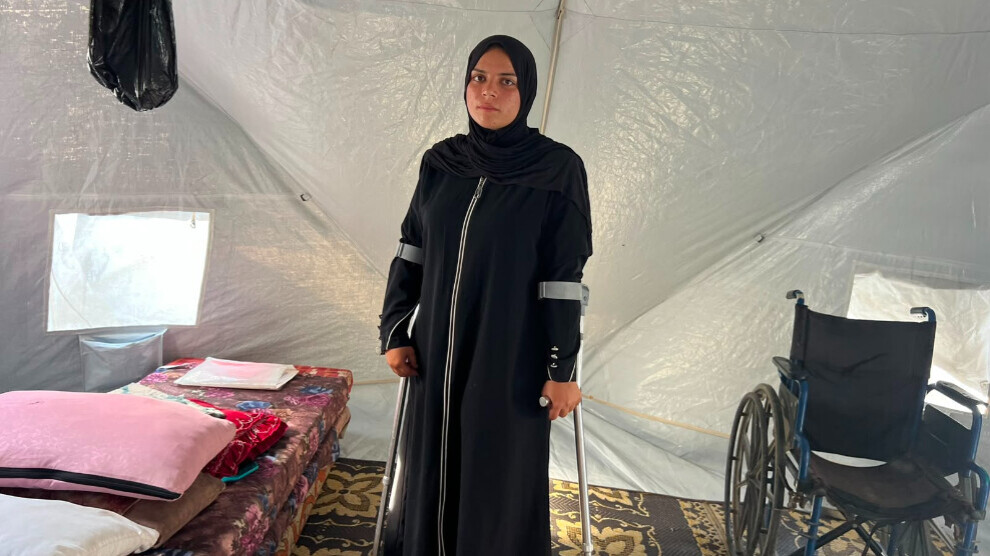
During the displacement, the wheelchair she depended on was damaged due to traversing broken roads. She was also compelled to leave her home in haste, leaving behind her prosthetic limb, which she had only managed to use four times due to difficulty adapting to it. Even the crutches she leaned on wore down from beneath from overuse, making mobility increasingly arduous over time.
She explains, "Everything I owned I left behind. I did not think about the prosthetic limb or anything else. My only concern was to survive with my family. But when I realized I had lost all means of movement, I felt more incapacitated than ever."
With the continuation of the war, her treatment trips to the West Bank ceased, and the medical follow-up that represented a safety net for her health was interrupted, leaving her in constant anxiety over the possible return of the disease without being able to conduct the necessary tests.
Despite the harshness of circumstances, her father tried to alleviate her burden, assuring her that this ordeal would pass just as she had overcome the ordeal of cancer. However, war held an even more painful tragedy in store for her.
In mid-2024, her father returned to the family home in Jabalia Camp to retrieve some winter clothing after the cold intensified, but Israeli forces' aircraft targeted him while he was in the area, killing him instantly, leaving behind his wife and five daughters to face life alone.
Clinging to Hope Despite All Difficulties
After his death, the details of daily life became more complex. There was no longer anyone to assist her with mobility or access to health facilities, while her dilapidated wheelchair increased her suffering rather than alleviating it.
With the escalation of military operations in Gaza City, Maryam Abd Rabbo, along with her mother and sisters, was forced to evacuate southward. The family moved between several shelters before finding a small room designated for widows and divorcees, housing more than five families in a single space, devoid of any privacy or suitable living conditions.
Within that cramped space, basic needs were unavailable, and the environment was unsuitable for a young woman who had lost one leg and required continuous health care, which exacerbated her psychological and physical condition.
After a period, the family managed to return to Gaza City, where a relative set up a dilapidated tent for them that became their only shelter. However, the tent was no safer than previous displacement stations, as it was invaded by insects and rodents, while lacking the most basic elements of dignified living. She says, "I fear illness as I fear loss. I live each day wondering: Has the cancer returned? Will I ever be able to reach the doctor who was following my case? What pains me most is that I have no answer."
Her suffering is not limited to the loss of treatment, but extends to the difficulty of movement within the city, as the distance to health facilities and the damage to her wheelchair prevent her from regular access to medical services, while every trip outside the tent drains what remains of her strength.
Despite all she has been through, she still clings to hope of resuming her treatment at the West Bank hospital and reclaiming her right to medical follow-up, of which she has been deprived since the outbreak of war, hoping to gain reassurance about her health and to continue a life that has stalled at the stations of loss, illness, and displacement.
Between a leg lost to cancer, a father taken by war, interrupted treatment, and a wheelchair worn out by rubble, Maryam Abd Rabbo continues to resist a reality that weighs ever more heavily upon her day after day. She asks for nothing more than an opportunity to complete her treatment and reclaim her right to movement and life, after the years of her youth have become an open battle with illness, loss, and war—yet the will to survive within her remains unextinguished.