
Two Palestinian sisters turn rubble into an innovation that won the International Earth Prize
From Gaza's destruction, sisters Tala and Farah Musa invented an eco-friendly brick from rubble. Their project symbolizes hope and Gaza women's creativity despite war, winning the International Earth Prize.
Rafif Asleem
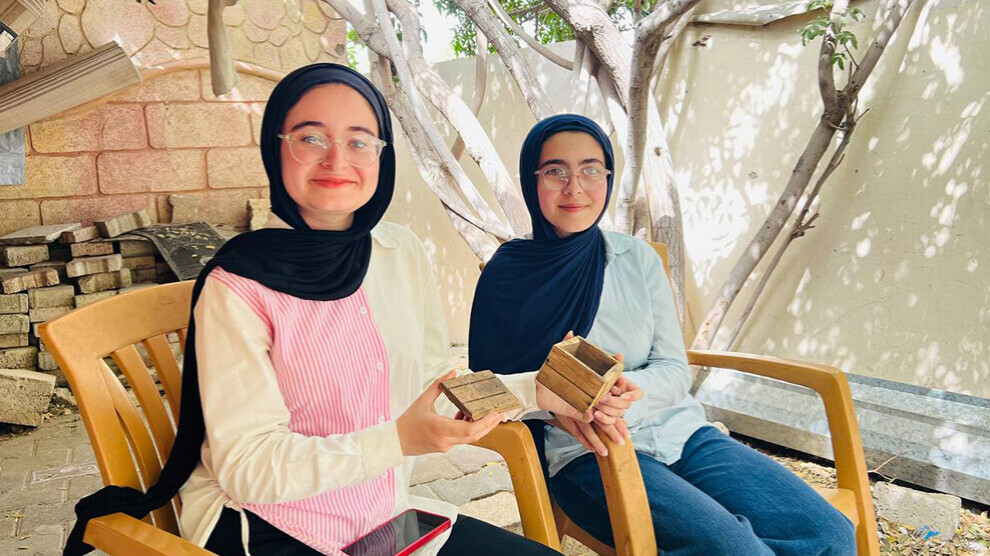
Gaza – Palestinian sisters Tala and Farah Musa won the Earth Prize 2026 for the Middle East region, which is the largest global competition and incubator of environmental ideas for young people aged 13 to 19, aimed at encouraging the creation of practical and effective environmental solutions on the ground. It is awarded by the "Earth Foundation" in Geneva.
The idea sparked in Tala Musa's mind when her city, Al‑Zahra, in the central Gaza Strip was bombed, and every street, neighborhood, and landmark was destroyed. The main question swirling in her mind was: how can this destruction be rebuilt using available resources in an environmentally friendly way that saves it from the ruin surrounding it?
From destruction to a brick that rebuilds
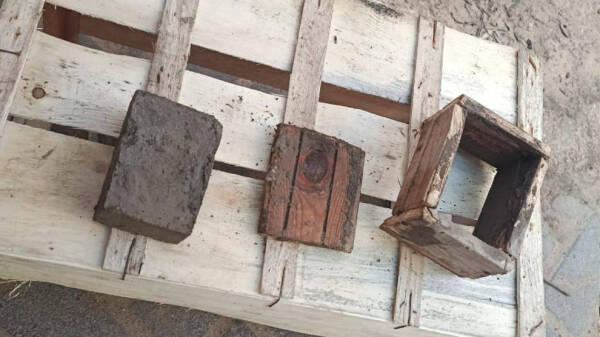
Tala Musa says that the brick was the optimal choice, made from the rubble itself. All that is needed to produce this brick are stones from destroyed homes, clay extracted from agricultural lands, crushed glass, in addition to straw and ash from cooking. All these components are carefully crushed until they become like flour, then water is added, poured into a mold, and left to dry.
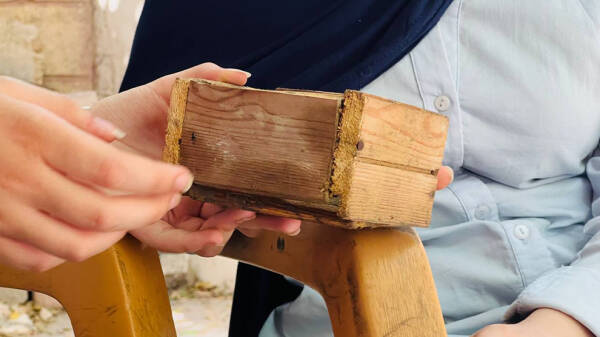
Regarding the brick's resistance to water and pressure, she noted that several experiments were conducted to measure its endurance, and the results were very satisfactory. The brick is strong, withstands water, and does not collapse from the first moment, especially given climate fluctuations. She pointed out that the brick is suitable for repairing homes, sidewalks, internal partitions, and anchoring tents to prevent them from flying away in winter.
Tala and her sister did not face any problems while working on the prototype, but conducting experiments during the famine and war was extremely difficult for them. She affirmed that her project is 100% environmentally friendly, as it contains no cement or lime, and at the same time solves an existing environmental problem: the presence of tons of rubble with no solution or disposal method. The brick is temporary, but it will help the stricken city.
Tala Musa explained that the next step is to hold workshops throughout the Strip to teach young people how to make this brick, and each young person will be required to sign a pledge to teach others. The goal of the project is not to build brick factories, but to help individuals – whether young people or women – to rebuild destroyed homes and create shelter that protects from the elements and preserves human dignity inside.
She does not deny that women in the Gaza Strip have been marginalized, especially since the beginning of the war. This prize came to prove the extent of women's and girls' ability to inspire and innovate in society. They are heroes and deserve this win. She indicated that she receives moral support from family, friends, and the media. "The city will be rebuilt by its women and its youth."
Creativity that transcends displacement and creates hope
For her part, Farah Musa pointed out that the working atmosphere between her and her sister was full of cooperation and enthusiasm. They divided the practical parts – from collecting stones and glass to conducting scientific experiments, and even communicating with the competition committee and fulfilling requirements. She noted that displacement, movement, and housing instability were the only obstacles; they never knew whether they would stay or leave the area.
About the feeling of winning, she explained that with each step she took, she kept the dream of winning before her eyes, even imagining the day she and her sister would hear the news. What increased her happiness when the win was announced was that she raised the name of Gaza City and removed from its shoulders the stereotypical image associated with war, poverty, and destruction – proving that young women from within the stricken city can innovate and give their best.
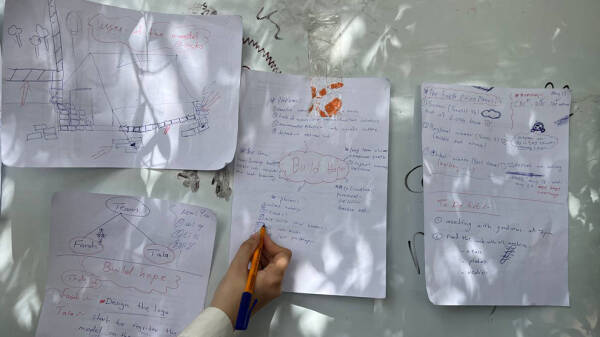
She added that this brick can help any city stricken by war and conflict, not just the Gaza Strip. For this reason, the project was named "Belt Hop," symbolizing building hope. She noted that participating in the Earth Prize added new skills to her and made her think about new projects that could serve the city, especially since she still has many ideas but is waiting for the right opportunity.
The jury stated in a press release that the sisters are the first regional winners from Palestine since the prize was launched. The winning teams receive a financial grant to support and develop their projects, and public voting will open soon to select the global winner on May 29.
It is worth noting that the United Nations estimated that about 1.9 million people in Gaza – approximately 90% of the population – have been displaced since the war broke out in 2023 until early 2025. Damage in the Strip was estimated at around $70 billion, with millions of tons of rubble spreading across the streets.