
A woman in her fifties clings to a worn‑out net to face life's hardships
Since her childhood, Sabra Khallaf has been attached to the Nile, turning her early passion for fishing into a profession through which she resisted the harshness of life for forty years, defying society's looks and the difficulty of the work.
Eman Samir Ali
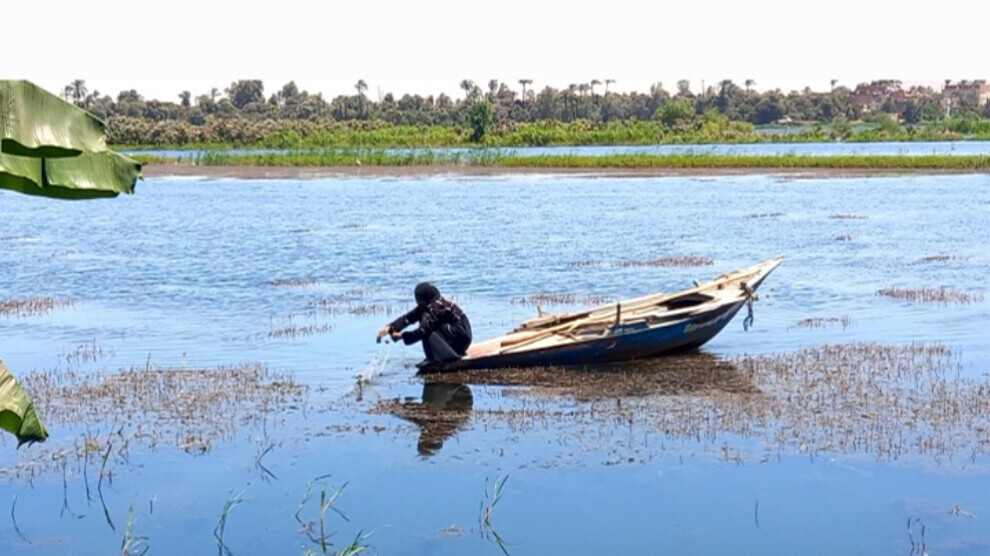
Egypt – On the banks of the Nile in Upper Egypt, Sabra Khallaf sits holding her worn‑out net, trying to repair what days and water have damaged. A woman in her fifties who chose an unusual path in her society, becoming one of the very few – perhaps the only one – among Upper Egyptian women who have taken up fishing as a profession and a way of life.
Sabra Khallaf says that she began her journey with fishing when she was ten years old, without anyone guiding her or pushing her from her family. Neither her father nor her mother worked in this profession, but she found herself drawn to the Nile from an early age, until it turned from a simple hobby into a lifelong passion that accompanied her for forty years.
Sabra Khallaf grew up in a house overlooking the Nile, and there her story began. At first, she used a "head cover" for fishing, then she began learning on her own until, over the years, she was able to buy her own boat and work daily on the water. She affirms that what kept her in this profession was not money, but her great love for it, even though the income barely covers life's needs.
In her talk, she recalls the difficult beginnings when she did not own a boat, so she used a wooden barrel to float on and move through the water. She says with a laugh: "I used to float on the barrel, and later I managed to get the boat." But the boat that provided her with a livelihood is now dilapidated, in constant need of repair, while she stands unable to afford the maintenance costs.
She starts her day in the evening, when she goes down to the river to set the nets, then returns in the morning to collect them with whatever meager catch they hold. In winter, her trips decrease because of the cold and her declining health, especially after long years spent diving and working in the water.
Despite the harshness of the profession, Sabra Khallaf believes that work is "honor and dignity," affirming that she has never stretched out her hand to anyone, and that she prefers to rely on her own strength no matter the circumstances, pointing to her cracked fingers, saying that the weariness of her hands is preferable to her than begging.
But the path was not easy. Besides the hardship of the work, she faced repeated harassment from some fishermen who reject the presence of a woman among them on the river. Nevertheless, she never thought of leaving the profession she has been attached to since childhood, affirming that she has become accustomed to facing fear, loneliness, and working at night on the water without hesitation.
Today, Sabra Khallaf relies on a "Takaful and Karama" pension that does not exceed a few hundred pounds, at a time when she needs a new net and a boat fit for work, as well as electricity to preserve the fish that spoil quickly due to the heat. She says that the lack of electricity sometimes causes her effort to go to waste when she has to throw away spoiled fish.
Amid all these difficulties, she continues her daily journey with the Nile, holding onto a profession she chose for herself since childhood, defying society's looks and the harshness of circumstances, believing that struggle and work are the only way to a life that preserves a person's dignity.