
Kefah Al‑Fakouri… a woman who reshapes her presence after every new loss
A Palestinian photographer, losing her leg through repeated surgeries due to lack of treatment, survives a massacre and loses family, yet documents displacement, turning her camera into a tool of steadfast resistance.
Nagham Karaja
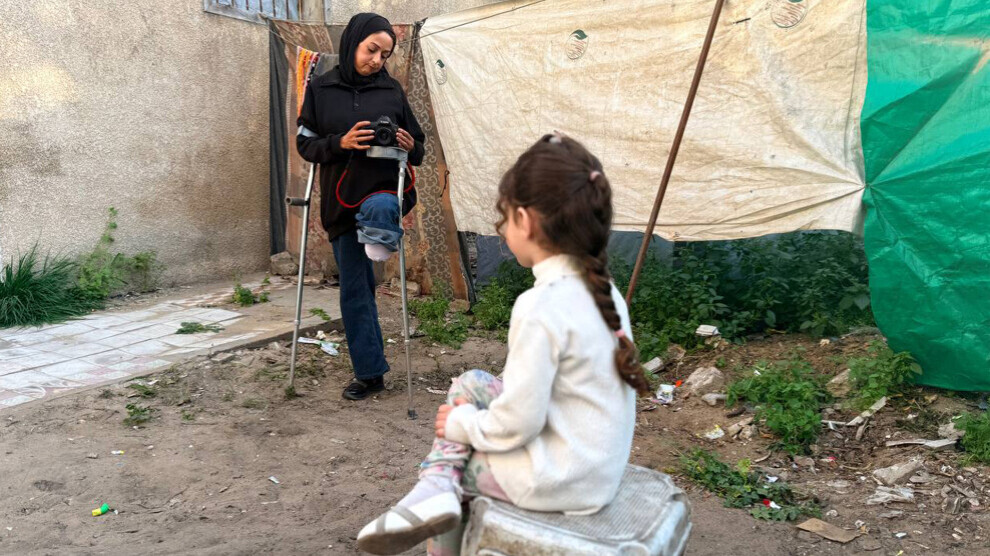
Gaza - On one of the displacement streets west of Gaza, Palestinian photographer Kefah Al-Fakouri sits in front of her tent. She places her camers beside a body exhausted by wounds and holds it with the same hand that survived from under the rubble. Her scene doesn’t appear ordinary in an area weighed down by displacement, as the lens has become for her an extension of a spirit that refuses to be exitinguished – despite her accumulated physical loss, and despite the harsh transformations that completely changed her life after a bloody targeting that struck her while returning from work in mid-June 2025.
The details of the story go back to the moment when Kefah Al-Fakouri, 35 years old, didn’t expect the road to turn into a massacre. She was accompanied by her colleagues after finishing a field mission when the group was directly targeted near Al-Baqa Café, resulting in many casualties. Only she survived. In that moment, she found herself in the middle of a scene of blood and rubble, unable to comprehend what had happened in the first minutes.
Kefah Al‑Fakouri says in a painful testimony: "I did not hear the sound of the explosion. All I saw was that my foot was no longer there as it used to be, and around me were lifeless bodies. At first, I thought someone would come to rescue me. I approached a person next to me, shook him and said, 'I am alive,' but he did not answer. When I turned him over with my hand, I discovered that his arm was severed and he had passed away. At that moment, I completely lost consciousness."
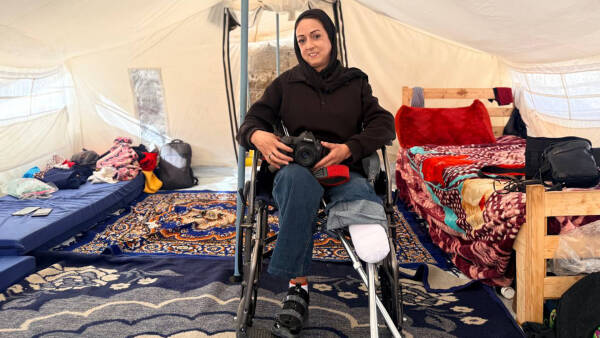
After being transferred to the hospital, a long journey of pain and complex medical procedures began. But it was not a journey of recovery in the traditional sense, as it turned into a series of successive surgeries. During her treatment period, Kefah has undergone 18 operations to this day. In each surgical intervention, she lost an additional part of her leg due to the continuous deterioration of her condition and the lack of appropriate medical capabilities inside the Gaza Strip, where the health sector suffers from a severe shortage of equipment, medicines, and specialized surgical supplies.
Over time, amputation has not become a fixed event at a certain point, but rather a recurring condition that worsens with each operation. The injury started with one foot, then gradually extended upward along the leg, until the current situation has reached a near‑complete amputation of the lower limb, due to the impossibility of providing comprehensive treatment that stops the spread of complications or treats the recurring infections. In the coming week, Kefah Al‑Fakouri is preparing for a new surgery expected to bring with it an additional amputation of the same leg, continuing a harsh medical path that has not stopped since the moment of injury.
Lack of supplies led to sequential complications
This medical reality cannot be separated from the broader context in which the health system in Gaza operates, where the wounded face their fate amid a shortage of surgical tools, the absence of some basic supplies, and delays in medical transfers outside the Strip. In the case of Kefah Al‑Fakouri, this shortage led to sequential complications that made each operation a new point of loss in the body, rather than a step toward recovery.
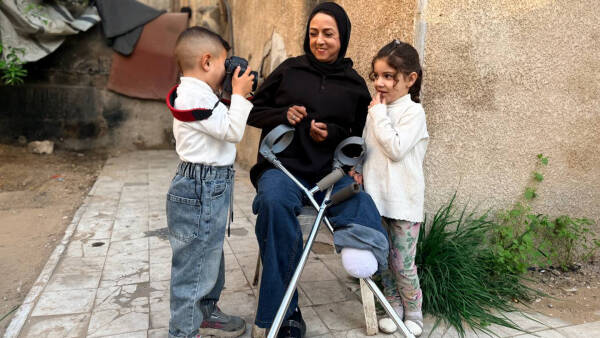
Despite that, she has not withdrawn into her pain. The photographer who carried her camera before the war has returned to it after the injury, as if she is reorganizing her relationship with life through the lens. She insists on documenting people's details in the camps – the life of displacement, children's faces, scenes of long waiting – as if she is saying that the image has become her only way to resist physical incapacity.
Kefah Al‑Fakouri explains: "I lost my foot, then part of my leg. Each time I thought the pain had reached its peak, I discovered that the next surgery carried new loss. But I have not stopped photographing, because the image for me is not just a profession; it is my way of staying present among people."
Kefah Al‑Fakouri's suffering is not limited to physical injury. She is also experiencing a painful series of family loss after the killing of her father and brothers during the war, which has made her bear the burden of life alone in a harsh displacement environment. Between one tent and another, she tries to secure her family's needs amid the lack of income and the continuation of difficult humanitarian conditions that pressure thousands of displaced families.
In the surroundings of her tent, the place turns into a dual space: part of it is dedicated to treatment and waiting, and another part to work and photography. The camera here does not only capture images of others, but also reflects the image of its owner, who stands at the border of pain and determination at the same time.
She adds: "I want a prosthetic limb that restores my ability to move – not to escape reality, but to continue my work as I was, and to prove that no matter how worn out the body may be, it can still carry a message."
Her camera… a living witness and a means of documentation
The experience of Kefah Al-Fakouri encapsulates a part of the story of Palestinian women in Gaza, where loss turns into a space of resistance, and pain intersects with the determination to continue. She isn’t merely a Survivor of a targeted attack, but a model of a woman who redefined her role after the injury, transformed her camera from a Professional tool into a living testimony of what is happening, and from a means of documentation into an act of Daily steadfastness.
In light of this scene, her story remains a witness to a complex medical and humanitarian reality, to the human capacity to hold onto life even as limbs erode, and to a woman who chose to remain standing after losing part of her body – so that the image she captures remains an extension of her voice, which has never ceased.