
After three years of conflict... How is the educational process faring in Sudan?
After three years of conflict, education in Sudan faces unprecedented challenges affecting schools, students, and teachers. Despite destruction, displacement, service disruptions, attempts at resilience continue as hundreds of thousands of students take t
Aya Ibrahim
Sudan — Since the outbreak of conflict between the Sudanese army and the Rapid Support Forces on April 15, 2023, the education sector in Sudan has found itself at the heart of a suffocating crisis that has affected its structure and threatened the future of hundreds of thousands of students. Students have collided with a harsh reality that has cast a shadow over their educational journey and created unprecedented challenges for the continuation of the learning process.
Despite this turbulent scene, there are attempts to secure educational stability, maintain the regularity of schooling according to the academic calendar, and ensure that examinations take place on their scheduled dates.
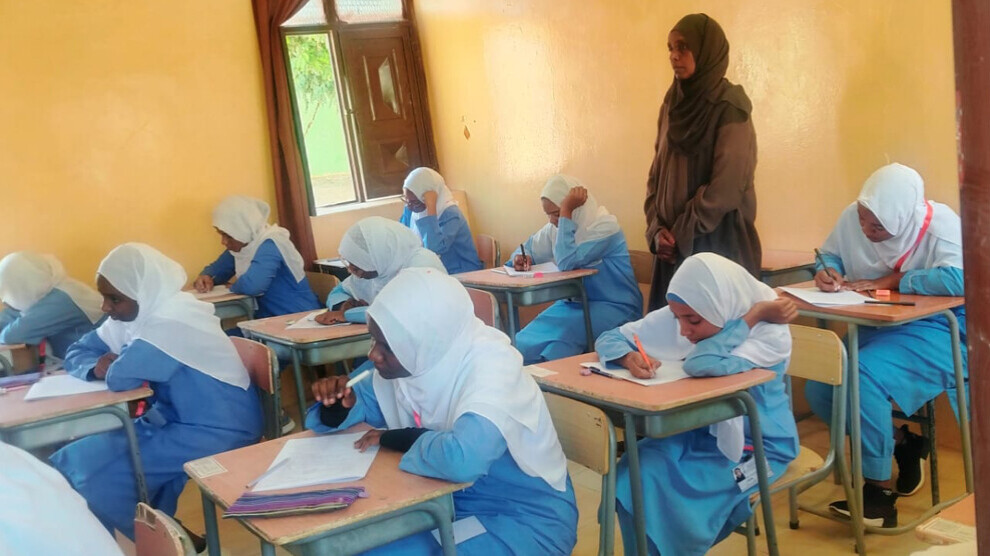
In this context, on Monday, April 13, 560,000 male and female students began taking their secondary school examinations, which qualify them for university admission. This is the third examination session held since the outbreak of the conflict, a step that reflects the determination to protect students' right to education despite all challenges.
Challenges of the conflict and attempts at resilience
Regarding the continuation of the educational process, teacher Maria Ahmed Othman affirmed that the education sector has faced significant challenges over the past three years as a result of the conflict in the country. She explained that power outages are among the most prominent obstacles facing students and teachers. However, she indicated that conditions are relatively better given the surrounding circumstances, affirming students' ability to adapt and confront these challenges.
Estimates indicate that millions of children have been deprived of their right to education, while thousands of schools have been destroyed or converted into shelters for the displaced. Schooling has also been disrupted in most areas of the country, which has led observers of the educational process in Sudan since the outbreak of the conflict to affirm that the sector is experiencing an "unprecedented crisis" characterized by the collapse of educational infrastructure, the deprivation of millions of children from attending schools, in addition to the displacement of large numbers of teachers and students, and the weakness of available alternatives for education.
Despite this difficult reality, these observers point to "serious attempts at resilience and continuity" in the educational process, in an attempt to face challenges and preserve what can be preserved of students' right to learn.
For her part, student Imtinan Ahmed Mohamed, who managed to take her secondary examinations this year, said: "I left with my family from the city of El Fasher in North Darfur state in search of safety and education. During our displacement to the Northern State, we were subjected to looting and killing."
She noted that she was forced to take her secondary examinations even though she was unable to continue studying in the term preceding the exams due to the conflict conditions. She thanked the people of the area to which she was displaced for their hospitality and shelter, saying: "The school administration received me well. Thanks to them, I was able to take my examinations."
In turn, teacher Zainab Mohamed Saleh explained that the educational process over the past years has gone through difficult conditions due to the conflict now entering its fourth year. She pointed out that the biggest challenge lies in the psychological instability of students, as it affects their level in examinations and their preparation for them, affirming that despite the difficulties, everyone faced that and managed to overcome it.
She noted that the 2024 batch of students were the most affected, to the extent that their examination results were not at the hoped-for level. She indicated that a large number of states were unable to complete the academic curriculum or cover the required syllabus during the year, which directly reflected on students' performance and level of readiness.