
Young Tunisian Artisan Gives Traditional Gharbal a New Artistic Life
Young Tunisian artisan Douaa Jradi is reviving the traditional Tunisian sieve (gharbal) by transforming it into decorative art pieces that preserve the country's cultural heritage.
IKHLAS AL HAMROUNI
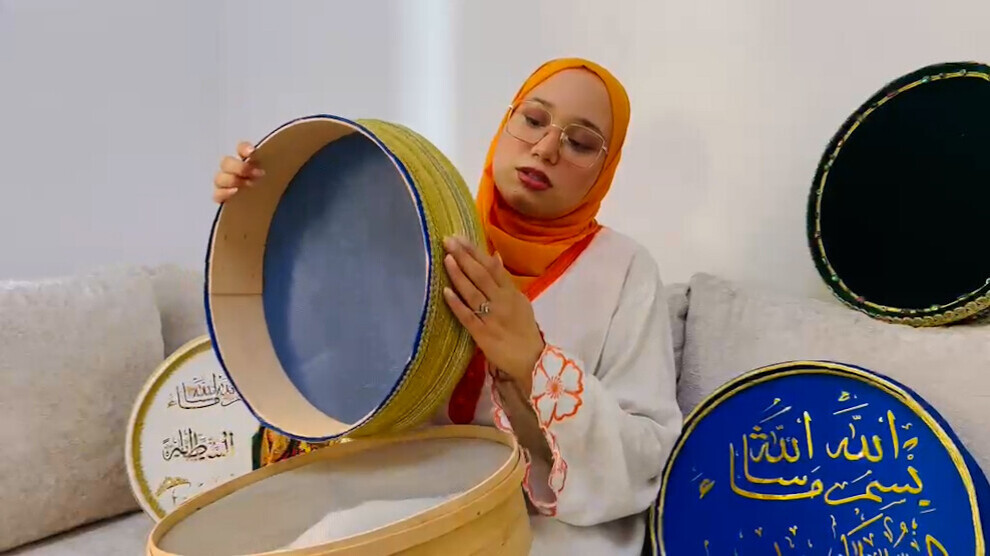
Tunis — Young Tunisian artisan Douaa Jradi chose to carve a unique path in the world of traditional crafts, keeping a single goal in mind: preserving Tunisian heritage and representing it in a contemporary style. She found no better medium than the Tunisian sieve (Gharbal)—a tool closely tied to the daily lives of Tunisians for decades—breathing new life into it as an artistic piece that decorates homes and reflects the identity of its owners. This experience blends authenticity with creativity, proving the ability of Tunisian women to transform traditional crafts into cultural and artistic projects.
Artisan Douaa Jradi stated that her relationship with the sieve was not a coincidence but rather stemmed from her belief that this heritage piece holds great symbolic value in Tunisian folklore. She explained that the sieve was historically present in many old customs and beliefs, as some believed it wards off negative energy and retains beautiful things. This prompted her to ask: Why not transform the sieve into an art piece that highlights its beauty while preserving its symbolism at the same time?
She added that this idea drove her to present the sieve in a fresh design, moving away from its traditional use. It became a decorative piece featuring the owners' names, special phrases, or patterns of choice. She emphasized her commitment to ensuring that every piece is unique, so no client feels they own a duplicated item.
"To me, every sieve has its own story and charm. I work on its details according to the owner's personality and desire, whether in terms of colors, patterns, or calligraphy."
She pointed out that she does not rely on ready-made templates; instead, she discusses with each client their desired shape and preferred colors, red, green, white, or others. She then begins executing the work to match their taste, resulting in a personalized piece that carries their unique touch.
Regarding the stages of creation, she says the work begins first with selecting an authentic Tunisian sieve, as she refuses to use any modern alternatives. For her, preserving heritage starts with maintaining the authenticity of the raw material itself. After that, she prepares various elements, especially the decorative patterns, before moving on to the stages of design, assembly, stitching, and writing. Finally, she assembles all the components in the last phase, which is the most precise step—so that the sieve emerges in its final form as a complete work of art.
She emphasized that every artisan has their own working method. As for her, she chose an approach based on respecting the traditional sieve and adding an artistic touch without compromising its original spirit, because her goal is not to alter heritage, but rather to showcase it in a new light.
Regarding the most prominent challenges she faces, she mentioned that the greatest difficulty lies in the fact that very few artisans still manufacture the traditional Tunisian sieve, which threatens this craft with extinction. She added that she is determined to work only with the authentic sieve to help sustain this industry, expressing hope that more artisans will return to producing it so it does not vanish from Tunisian heritage.
Tunisian Traditional Crafts Are Capable of Reaching a Global Audience
Concerning her designs, Douaa Jradi said: "I draw much of my inspiration from Tunisian heritage, especially from the traditional motifs and embroidery used in the Tunisian Jebba and other heritage costumes. At the same time, however, I leave plenty of room for my artistic imagination. Combining authenticity with innovation is what gives the work its uniqueness and makes it appeal to diverse tastes."
She added that transforming the sieve into a decorative piece was initially an unconventional idea, which surprised many at first. However, it quickly gained appreciation and admiration once people saw the new form the sieve had taken. She noted that demand for these works has gradually increased within Tunisia, and she has also started receiving orders from abroad. She considers this an indicator that traditional Tunisian crafts are capable of reaching a global audience if they find someone who can develop them while simultaneously preserving them.
She asserted that her biggest dream is for her brand to become well-known both inside and outside Tunisia, and for the Tunisian sieve to reach all corners of the world, serving as an ambassador for Tunisian heritage.
Douaa Jradi concluded her remarks by hoping that the world would see the beauty of this heritage piece and the creativity it can embody:
"Tunisia is rich in traditional crafts that deserve more attention and support. Preserving them is a collective responsibility, as they represent part of the country's identity and its cultural memory, which must be passed down to future generations."