
"The Daq": A Living Document of Women's Memory and Identity
The ancient tradition of "Daq" on the bodies of Kurdish women goes beyond being mere decoration; it is a living document of ancient beliefs, an unwritten history, and a feminine identity. This tradition has recently begun to spread again.
SARA POURKHAZRI
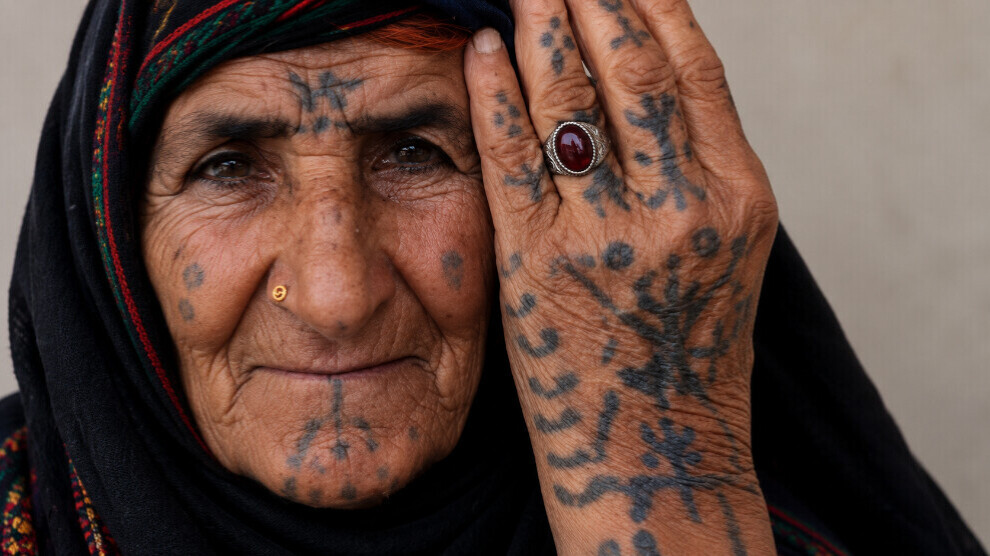
Kermanshah — On the faces and hands of elderly Kurdish women, from Kermanshah, Ilam, Sanandaj, and Mahabad in eastern Kurdistan to Duhok in the Kurdistan Region, engravings known locally as "Daq" appear, evoking the sun, moon, constellations, and stars. These marks are not merely decoration; they are rooted in ancient beliefs passed down orally through generations.
These tattoos serve as a living document of a people's memory and as a bridge between the past and the present; they are engravings that established a deep connection between women's lives and the spiritual world around them, and recorded history and myth on their bodies.
Maria T., a history student, says that "tattooing has a history as long as human history. Archaeological evidence indicates that more than five thousand years ago, humans were drawing permanent engravings on their bodies; these engravings had religious, doctrinal, healing, and even social functions."
This historical antiquity shows that Daq tattoos in Kurdish regions "also extend back to very ancient eras and are not a phenomenon confined to recent centuries."
She explained that "many of the designs we see today on the bodies of elderly Kurdish women were in the past engraved on the surfaces of pottery vessels, ritual tools, and daily objects as well; this represents clear evidence that these designs carried deep meaning and concept and were not merely aesthetic. This connection between the engravings on the body and ancient decorations has made Daq part of the cultural memory and visual heritage of the Kurdish people."
Tattoos as part of protection and healing
The ancient tattoos that trace their roots to ancient Mesopotamia, according to Maria T., were present among Kurdish women, especially in areas inhabited by followers of Yarsanism in Kermanshah, and went beyond the concept of beauty to become part of a worldview, sanctity, protection, and healing.
This tradition declined sharply in recent decades due to social and political transformations and the emergence of new beliefs, and today it is only seen among elderly women. However, recent years have witnessed a new wave of reviving these engravings with the aim of restoring the connection to cultural identity and collective memory, while the oral narratives behind these engravings make them a profound subject for research and study.
Turan Aslani (a pseudonym) points to the engravings on her body with a look full of memories and says: "We used to draw the sun on our bodies so that light and radiance would always continue in our lives, and we would place the image of the flower and the bud so that youth and freshness would never leave us. My mother had a drawing of a pine tree on her hands and believed that this drawing healed the pain in her hands. Each one of these engravings had a special miracle; a miracle that gave our lives meaning and hope. But many of these beliefs have been forgotten today, and girls no longer accept tattooing, and this ancient tradition has gradually faded from memory."
Shiva S., a journalist who conducted research on this topic for some time, says: "My research focused on different areas of Kermanshah, but I found that the prevailing and similar beliefs existed in almost all of these areas; beliefs that show that most of the women who used to draw these engravings on their bodies had a shared understanding of the meaning of this ritual."
From her point of view, "one of the most important parts of the process of drawing these engravings is the primary materials used in them. They all used to emphasize the necessity of mixing lamp soot with the milk of a mother who had given birth to a girl."
Many believed that "the milk of such a mother makes the color stick better to the body and gives it greater durability." Another group said that "this ritual is entirely feminine, and the milk of a woman who has given birth to another woman must be used."
A form of women's resistance to restrictions
This belief, as she says, although it may seem at first glance simple or even superficial, in reality reveals deep layers of the origins of the Daq ritual; layers that indicate the value and status of women in local culture.
The Daq ritual, in its essence, "shows that women were able to make a decision about their bodies and create permanent engravings on them. This act was a kind of declaration of independence and ownership of the body." Although it was not directly prohibited by law in Iran during recent decades, social, legal, and patriarchal pressures "prevented women from being able to make even the simplest decisions related to their bodies, or even draw a simple and temporary henna design on them."
The details related to the origin of the Daq ritual and the beliefs surrounding it are in fact of great importance; because they show that this tradition, according to Shiva S., "was not merely an aesthetic practice, but a cultural and social expression." Daq in its hidden layers "reflects a form of women's resistance to restrictions and affirms women's right to choose and to create meaning on their bodies."
As for the images of the moon and sun, and especially the star, which were common among most women, they represent a reflection of ancient deities such as Ishtar, the symbol of love and fertility, and the mythological beliefs of ancient peoples.
This connection shows how ancient cultures infiltrated, without necessarily remaining preserved in individual memory, into collective memory and remained present and visible on women's bodies. These engravings are in reality the unwritten history of women; women whose names were not mentioned in history books, but who recorded the stories of their lives and the beliefs of their people on their skin and bodies. Today, these same engravings and drawings serve as a living document that reveals the secrets of women's history in Mesopotamia and the Kurdish regions and shows the hidden layers of culture and feminine identity.