
Arabic Calligraphy: Tunisian Women’s Passion Bridging Beauty and Identity
In a cultural center in Soliman, Tunisian women of all ages gather to learn Arabic calligraphy, rediscovering their heritage and expressing their identity through this timeless art form.
IKHLAS AL-HAMROUNI
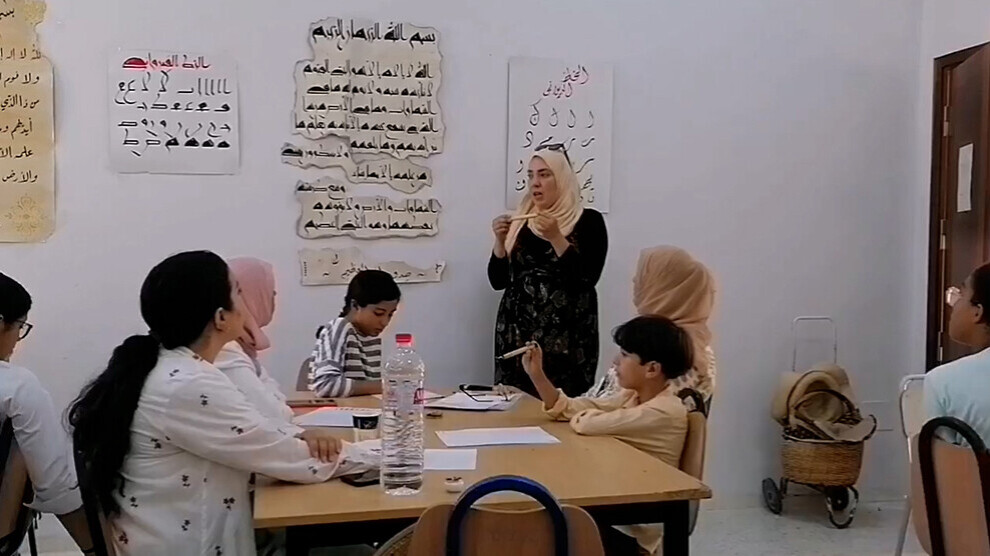
Tunis_in a quiet corner of the cultural center in the city of Soliman, in Nabeul Governorate, where light streams through the windows, Fatima Al-Maidini sat before a blank sheet of paper, her fingers carefully tracing beautiful letters with patience and focus, as if reliving similar moments from her past.
Fatima Al-Maidini's participation in the Arabic calligraphy club was not a fleeting visit; it was a return to a distant time—to the age of four, when she learned her first letters. Today, at seventy-five, she returns to the art that shaped her awareness. She returns to Arabic calligraphy, which has been and remains a mirror of her identity and an extension of her soul.
It is a moment that compresses a long time, embodying the meaning of holding onto roots in an age of accelerating life and fading beautiful details. There, in the calligraphy club hall that holds the stories of women, a new journey begins—or perhaps it is the continuation of a journey that began seven decades ago.
Seventy Years Since Her First Letters
Fatima Al-Maidini explains that she studied Arabic calligraphy from the age of four, then went on to primary school where she studied Arabic and French. She later returned to practicing calligraphy at a dedicated club, embarking on a journey that took her back to her four-year-old self.
Nearby, two baccalaureate literature students sat, among them Sirine Chouchy, who expressed her passion for the Arabic language and her choice of calligraphy for its close connection to Tunisian heritage. She says: "Arabic calligraphy is culture, art, and history, distinguished by its aesthetic character," affirming her admiration for the activity and her determination to continue until she masters the various calligraphy styles.
She believes that women's relationship with Arabic calligraphy is natural, as this art combines culture, beauty, and refinement—elements that align, in her view, with women's nature and attention to beauty and detail. She also thinks women may be more successful at practicing and mastering Arabic calligraphy due to their attention to order, precision, detail, beauty, and ornamentation—qualities that help them shape letters with their fingers creatively.
Sirine Chouchy encourages young women to join the calligraphy club and contribute to reviving this art, which is an important part of Tunisian heritage and history, urging them to continue in this field and work on developing their skills.
For her part, Aya Makhloufi, also a baccalaureate literature student, said she participated in the calligraphy activity because she found in it refinement and beauty, as an art that combines creativity and authenticity. She sees calligraphy as similar in detail to women, reflecting an important aspect of Tunisian heritage, in addition to its diverse forms—including Ruq'ah, Kairouani, and Diwani scripts.
Having found her passion in this club, she encourages anyone who wishes to join such activities and specialize in Arabic calligraphy, affirming that this art allows one to enjoy and discover new aspects of their heritage and history.
Late Discovery and Renewed Passion
Zainab Bousaleh noted that her first participation in the calligraphy club—attending just one session—was enough to draw her into this field and push her to continue learning to master this art.
She believes Arabic calligraphy has a special aesthetic and spiritual character, which has turned it for some women into a hobby or artistic craft, creating calligraphy pieces that are hung on walls or used to decorate homes. For her, the beauty and elegance of Tunisian women meet the beauty and precision of Arabic calligraphy, seeing similarities and complementarity between them. She hopes Tunisian women will pay more attention to this art, regardless of their fields of specialization.
Passion for Art and Cultural Identity
Between Fatima, Sirine, Aya, Zainab, and other women and girls participating in the calligraphy club, instructor Nawal Al-Jammali moves lightly among them, offering explanations about the history and origins of this art and answering their questions.
Nawal Al-Jammali's relationship with Arabic calligraphy goes back years, when she began teaching it at the Tunisian Association for Calligraphy Arts, then at the Zaytouna Association for Knowledge and Sciences. She has given attention to various styles, particularly Ruq'ah and Naskh, along with others, driven by a desire to discover this art and deepen her understanding of its civilizational and aesthetic dimensions.
She explains that her connection to Arabic calligraphy stems from its being part of Arab cultural and civilizational memory, adding that her desire to learn and deepen her knowledge came from its diversity of schools, as each script has its own characteristics, history, and culture, and each era and group of peoples adopted specific scripts to express their civilization and cultural identity.
Regarding the types of Arabic calligraphy, she notes their diversity and functions, including Diwani script associated with official correspondence, Ruq'ah script common in daily writing, Tughra script used for sultans' signatures, along with Jali Diwani used to embellish official writings, and Andalusian script linked to writing in Andalusia. Tunisia, according to Al-Jammali, is distinguished by Kairouani script, used for ancient Qurans and manuscripts, while Kufic script is one of the most prominent scripts associated with Iraq.
She believes that Arabic calligraphy today lives in a phase between preservation and renewal. Some hold onto traditional learning and preservation, while others seek to develop it and employ it in new fields, especially commercial ones, by treating it as raw artistic material and reprocessing it using modern techniques and AI tools.
Regarding women's presence in calligraphy clubs and workshops, she considers that women and girls show remarkable interest in learning this art for its aesthetic qualities and the patience, contemplation, precision, and mastery it requires. She believes these characteristics intersect, in her view, with some aspects of women's nature, making them more inclined to learn and master calligraphy and sometimes employ it in various fields, including decorating women's clothing, adding distinctive aesthetic touches.
Nawal Al-Jammali affirms that the Arabic calligraphy club is one of the important clubs within cultural centers, as it allows participants to discover an art different from the activities they are accustomed to, such as robotics, dance, and painting. She also believes this art has a special educational value: it teaches patience, waiting, deliberation, precision, and mastery—values different from the nature of some activities based on delivering ready and fast results.
Thus, the Arabic calligraphy club appears not merely as a space for learning writing and ornamentation, but transforms into a space for discovering part of cultural identity, enhancing patience and creativity, and connecting new generations to an art that has witnessed the development of Arab and Islamic civilization across the ages.