
Algerian Novelist Recovers the Tales of the Saharan Woman
Algerian novelist Jamila Tablawi evokes the image of the Saharan woman as a symbol of resilience and rootedness, likening her to a “sand rose,” drawing inspiration for her literary experience from the environment of Bechar city and its cultural memory.
RABIAA KHREIS
Algeria – Amid the sands of the Algerian desert, with its pulsating memory and ancient cultural heritage, and in the pages of the contemporary Algerian novel, the Saharan woman is manifested as a symbol of resilience and authenticity, carrying in the details of her life a heritage rooted in the region's history. Among the prominent women's voices, novelist and media figure Jamila Talbawi stands out.
Jamila Talbawi is considered one of the prominent names in the Algerian literary and media scene. She was born and raised in the city of Bechar, located in southwestern Algeria, which is the capital of the Saoura region, where the surrounding desert environment formed part of her cultural and literary experience.
About the roots and first springs that watered her creative imagination, she says: "My first steps were embraced by the sands of Bechar, its alleys, and its mud palaces. My imagination was formed through the humming of mothers with those folk songs, through weaving sessions, the smells of spices, coffee, and Saharan tea on embers, and the traditional jewelry of women in the region. All these details accumulated in my childhood memory."
Although her academic and professional path took her toward the worlds of mechanical engineering, precise scientific specialization did not prevent her from entering the world of words, following in the footsteps of many great writers who specialized in medicine or law.
The external environment alone was not the maker of her talent; she also received great support that constituted a turning point in her life. About this support, she says: "My older brother was my role model, and he was the one who encouraged me to write since I was a small child. He allocated me a wing in his library, and then I gradually progressed through several readings."
Pens of the South Break Stereotypes
This heritage did not stop at the limits of childhood, but transformed in the writer's consciousness into a philosophical and literary vision through which she looks at the being of women in southern Algeria — a vision that Jamila Talbawi summarizes passionately: "The desert space is inspiring, and the Saharan woman is like the desert rose. An ordinary rose, when you pick it, wilts, but the sand rose, even when uprooted from its roots, never wilts but remains glowing. This is what I relied on when I wrote my long story about this rose, and I made the protagonist a doctor to confirm that the woman of the South has penetrated all fields."
From this standpoint of breaking the stereotypical image, she confirms that Algerian literature has done great justice to the Saharan woman, considering that this interest is not new, as there are many writers who have worked on the desert space since the 1930s.
Woman in the Mirror of Jamila Talbawi
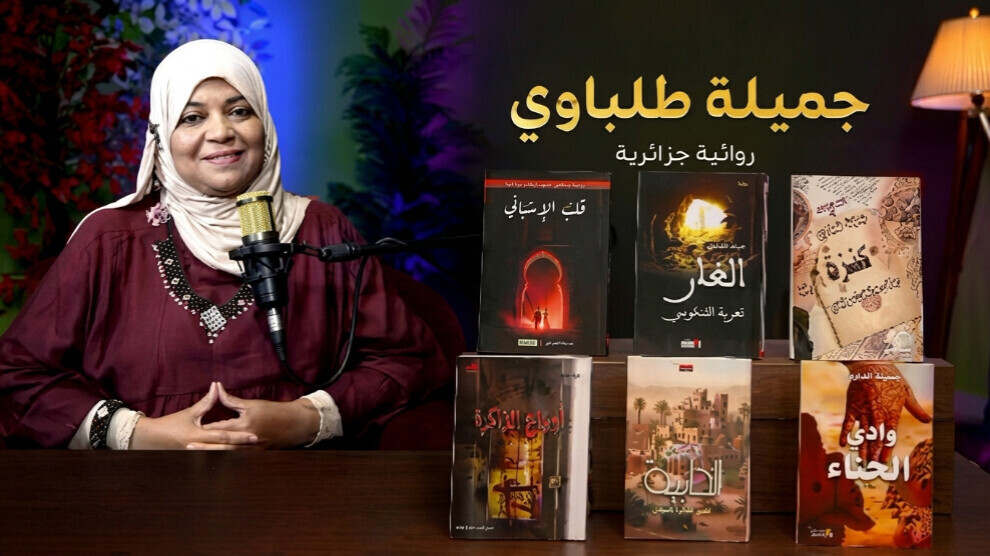
Jamila Talbawi did not content herself with observing fairness in the texts of others, but made it the cornerstone of her own novelistic project, which was clearly evident in her famous novel "Wadi Al-Henna" (The Henna Valley), published in 2017 by Dar Mim Publishing. In this narrative space, the novelist wrote her lines with inspiration drawn from henna papers, in an artistic celebration that glorifies and elevates women, contributing through the character of the protagonist "Aouicha" to removing the shackles of misery from her shoulders, as this Numidian woman embodies a symbol of resistance, defying all obstacles to reach her goal, and turning into a source of hope and a light penetrating for the rest of the women of her town.
However, the dimensions of the novel go beyond this admirable image, as Jamila Talbawi brings us down into the heart of "Timi," the historical name of Adrar, depicting an environment burdened with bitterness, injustice, and the sediments of ancient slavery. There, in the shadows and away from the protagonist's struggle, the tragedies of other women are revealed, women who drink various kinds of marginalization, women from whom the serenity of the soul has been taken, and the bonds of familiarity and compassion between them and men have been severed, and homes have become mere walls empty of warmth and containment. The dawn of emancipation and joy has been veiled from those oases, and images of happiness and humanity have faded under the dominance of a strict patriarchal society.
This extensive work on women's issues is by no means limited to one text or another, as Jamila Talbawi confirms that "women are strongly present in all her novels." She cited in this context her distinctive novelistic work "The Heart of the Spaniard," where the woman in the South was not absent from the scene but was embodied through the vision of the simple mother steeped in wisdom and depth, who managed from her perspective the struggle of human identity between East and West. This permanent presence reflects the writer's commitment to making women a fundamental pillar on which her narrative imagination rests in deconstructing the issues of society and the universe. This novel was crowned with the "Yamina Mechakra" Literary Award in the category of the novel written in Arabic.
Her creative testimony does not stop at this limit, but extends to be crowned in her novel "Al-Khabiya" (The Jar), through which Jamila Talbawi confirms that she presented the Saharan woman as she should be, transcending the tourist or fleeting folkloric view of the depth of the South. In this text, brimming with the aesthetics of mud architecture and the alleys of ancient palaces, the woman is no longer just a background to the scene, but is formulated as a true guardian of memory and place, and an active element pulsating with life, privacy, and the ability to confront sweeping social transformations without abandoning her authenticity.
This fairness is not limited to the cultural and social dimensions only, but extends to include the historical struggle, as the woman of the South recorded a remarkable presence in the novel "Al-Ghar: Taghribat Al-Qandousi," a novel linked to the crimes of the French occupation in the coal mines of the southwest.
In a related context, her novelistic work "Kenza" comes as an icon of honoring "the Saharan martyr and female fighter" who struggled and resisted for Algeria's independence, proving through these integrated narrative stations that the woman of the South has a hand in making history and freedom, just as she has a hand in preserving heritage and identity.