
Women's Protection Units fighters and testimonies of resilience that transcends war
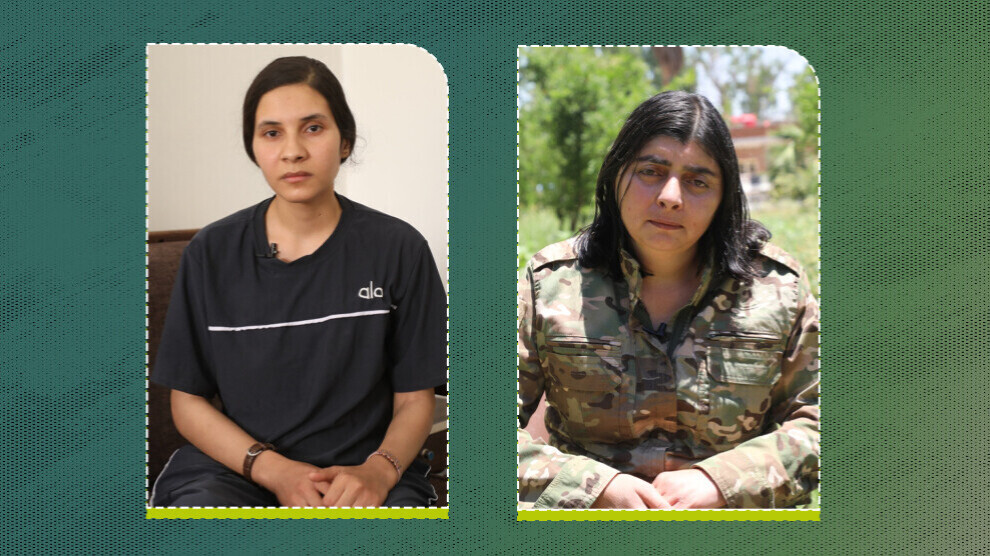
Two females in (YPJ) confirmed that the injury did not end their journey but rather changed their outlook on life and strengthened their determination to continue the path.
RONIDA HAJI
AL-Hasakah - Despite the harshness of war and the difficulty of life, the wounded women who were injured in the battles continue their journey with a will no less strong than that which they carried on the battlefronts. The female fighters of the Women's Protection Units confirm that the physical injuries did not end their journey, but rather gave them a new meaning to life and strengthened their conviction to continue the path of struggle.
“The injury changed my outlook on life.”
Frashin, who comes from the city of Siirt in northern Kurdistan, joined the Women’s Protection Units (YPJ) as soon as they were established in 2013. She says that joining gave her “a new sense of strength and self-confidence,” and that she not only played a military role, but also tried to raise the morale of her comrades during battles.
She added that she was injured during the battles against ISIS in Raqqa when a bomb exploded, and that shrapnel remains in her body to this day. "After my injury in Raqqa, I looked at life differently. My goal was to liberate the land from occupation and protect the people from genocide."
She believes that the Women's Protection Units (YPJ) "are not just a military formation," but represent "a legacy of resistance" forged by the sacrifices of hundreds of wounded and martyred female fighters. "These fighters played a fundamental role on the front lines and continued fighting despite the use of advanced weapons and drones against them. The unity of the various groups and the experience accumulated during the years of the revolution strengthened the community's connection to these forces."
She added that any project to build a new Syria, in her view, will not achieve equality and democracy if the Women's Protection Units (YPJ) are not granted their rights.
"Leader Öcalan's philosophy has restored women to their essence."
For her part, Didem Derik, also a war wounded, said that her joining the ranks of the female fighters as an Arab woman came after she became acquainted with the ideas of leader Abdullah Öcalan. She believes that these ideas "brought about a transformation within society" and had a particular impact on women, considering that they paved the way for women to regain their role and status, and that many of the gains women have achieved are due to this philosophy.
Didem Derik spoke about her participation in the defense of the Sheikh Maqsoud neighborhood in Aleppo, describing that period as "one of the most difficult experiences I have ever lived through." She said that the forces she faced used large numbers of fighters and advanced weapons, but she emphasized that this did not break the will of the defenders: "The enemy can possess weapons, but they cannot break the will to resist."
She affirmed that the resistance in the Sheikh Maqsoud and Ashrafieh neighborhoods was largely led by women, and that the siege imposed harsh humanitarian conditions. She explained that they, as fighters, provided medical treatment to the wounded in addition to participating in the fighting, and tried to help the besieged civilians, while the severe shortage of water and food exacerbated the suffering of children and women.
She also said that they sometimes had to use intravenous fluids to compensate for the children's lack of water, describing it as "one of the most painful scenes" she had witnessed.
Didem Derik recalled her comrade Deniz Cia, who was killed in action. She said they fought together in the same battalion and that she herself had been wounded in the leg. While receiving treatment, she learned of Deniz's martyrdom and vowed to recover and get back on her feet to continue the path her comrades had taken. "It's true we lost a part of our bodies," she said, "but we gained a stronger will to continue, and that's what gives us the strength to keep living and fighting."