
With Simple Means… Afghan Women Lead an Initiative to Rehabilitate a Vital Road
Afghan women in Daykundi province took initiative to manually rehabilitate a vital local road using simple tools, successfully easing daily travel and life for their community.
Baharan Laheeb
Afghanistan-Afghanistan is plagued by rugged and treacherous terrain. Even after the winter season ends and heavy snowfalls cease, many villages still struggle to access cities or district centers for basic services and daily necessities.
The poor condition of the roads has had severe consequences for the population, ranging from the isolation of villages from cities to a rise in maternal mortality rates during childbirth. Additionally, vehicle accidents are frequent, with cars plunging into deep valleys adjacent to the roads—accidents so severe that, at times, the victims' bodies cannot be recovered.
Over the past decades, wars, foreign interventions, and political instability have hindered Afghanistan's development, depriving residents of the most basic necessities of life. Even today, some Afghan provinces lack paved and properly prepared roads connecting them to the capital, Kabul, forcing residents to risk traveling through rugged and dangerous routes to secure their needs.
Estimates indicate that flat land accounts for only about 20 to 25 percent of Afghanistan's total area. Consequently, most roads between provinces and districts pass through towering mountain ranges, which further exacerbates the hardships of daily life for the population.
Despite these conditions, Afghan citizens have on numerous occasions resorted to symbolic methods to voice their demands. In Bamiyan city, for instance, the absence of paved roads was a catalyst for repeated public protests for many years. After official demands were ignored, the city's men and women paved one of the main roads using mud and straw in a symbolic gesture. Later, they erected a protest arch in one of the city's squares. These actions garnered widespread media attention, prompting the authorities at the time to respond to the residents' demands and pave the city's roads.
Roads Threatening the Lives of Residents
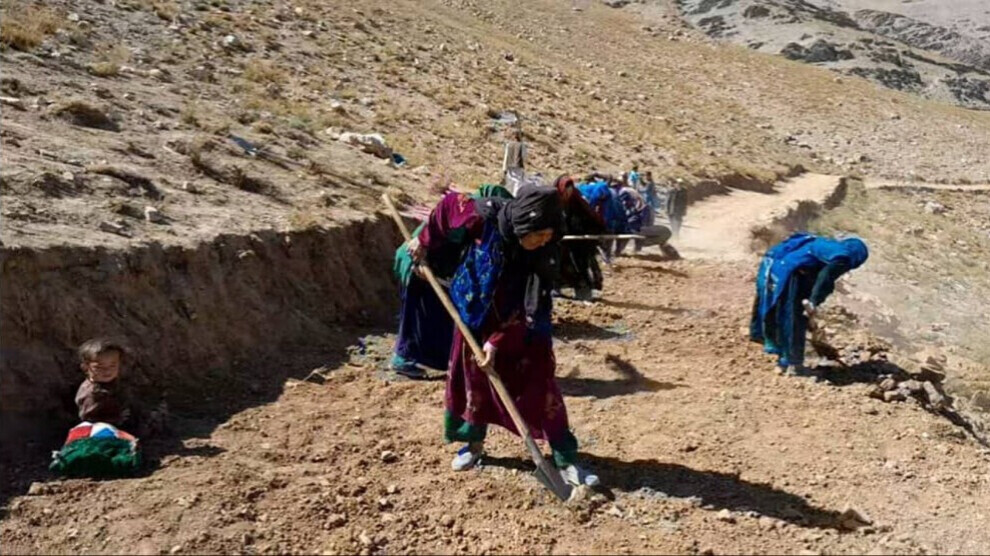
A few months ago, a number of residents from a district in Daykundi province, including women, undertook the rehabilitation of a section of a road as both a voluntary effort and a form of protest. Although the road remains unpaved, it witnessed the passage of the first truck loaded with essential supplies for the residents about two weeks ago.
Daykundi is one of the most isolated provinces in Afghanistan, where residents sometimes need two days to reach Kabul via rugged dirt roads. Furthermore, many districts and villages lack health centers. Nevertheless, its residents place a high value on education, resulting in a relatively high literacy rate compared to other regions.
Most residents of Daykundi rely on livestock herding, agriculture, and gardening. According to local witnesses, maintaining this road will help shorten the distance between Daykundi and Kabul. The province also experiences heavy snowfall during the winter season.
After extensive efforts, our agency managed to interview two women who actively participated in this project and agreed to speak about their experience.
When the residents decided to rehabilitate the road, they used the simplest available tools and resources. As in many community initiatives, women were at the forefront of the participants.
Shakila Ahmedi, a resident of Jah Chan village, said:
"The motivation that drove me to participate in building the road is that I have traveled to Kabul and Ghazni, and I realized the importance of this route because it connects Daykundi to Ghazni via a shorter distance."
She added: "All the women in our village participated in building the road. Even though we were doing household chores like childcare, cooking, baking bread, and other tasks, we also actively participated in the work. We would finish our housework at night and then head out at 8:00 AM to rehabilitate the road. I have four children, and the number of participating women was large; about 40 women worked with us."
Shakila Ahmedi sent a message to women in remote areas of Afghanistan, saying: "Work is not limited to men or women; rather, everyone must make an effort to achieve their goals and make life easier."
Fatima Mohammadi, another woman who participated in the project, said:
"The reason for my participation is that this road is close to provinces like Bamiyan, Ghazni, and Kabul. When one of us fell ill, we had to travel for long hours, but now the distance has become shorter, which is why I took part in this work. Around 40 to 50 women participated in building the road, alongside our household responsibilities, because we wanted to provide easier living conditions for ourselves."
She concluded with a message to Afghan women, emphasizing that "women in every region must have determination like ours and work to make their lives easier."