
Violated Bodies: Syrian Women Caught in the Trap of Security Chaos
Syria's security chaos exposes dominant forces' culpability, as ideology and complicity turn women's bodies into a battleground for political and sectarian vengeance.
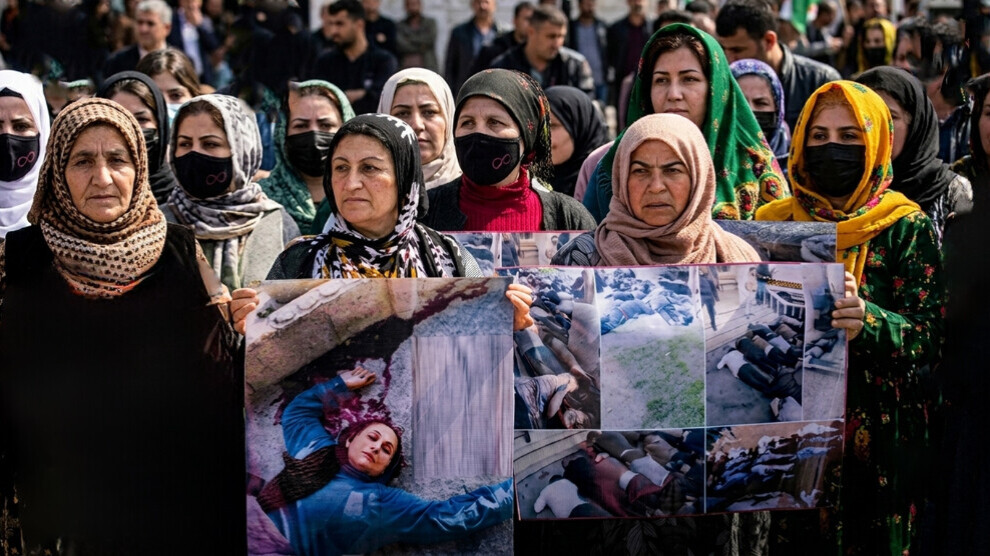
SILVA EBRHIM
News Center — The reality of women in Syria today transcends the boundaries of statistics, reflecting the depth of a tragedy produced by an extremist authority imposed by the dominant forces—an authority that, in a year and a half, condensed decades of Ba'athist tyranny. This transformation has proven the failure of a movement that was content with changing the oppressor without uprooting oppression, turning women's bodies into an open arena for systematic violations and unjust security chaos.
What women in Syria are experiencing is not merely mute numbers or transient situations but the outcome of a crisis raised in the name of revolution, yet reproduced an extremist and unjust authority forged by the hands of dominant powers, foremost among them the United States and Israel. This new authority condensed the misery and oppression of decades of Ba'athist rule in just a year and a half! This period was sufficient to prove that most revolutions fail when they are content with changing the oppressor without uprooting oppression—exactly as depicted by novelist George Orwell in his famous work Animal Farm.
Since the rise of Hay'at Tahrir al-Sham jihadists to power, Syria has witnessed a pervasive state of security chaos in which women have been the greatest victims of this catastrophe. This deterioration was not the result of a natural security vacuum accompanying transitional phases after the fall of the Ba'ath regime, but because the new authority itself was a primary partner in entrenching chaos in Syrian cities, in addition to its sponsorship of sectarian and ethnic attacks amounting to war crimes against Alawites, Druze, and the Kurdish component.
What we speak of here is not merely narratives or oral accounts circulating in society but a bitter reality etched onto women's bodies, reflecting the sole truth of those running Syria today—those who boast in international forums of wearing suits and ties to conceal their true faces. It is a reality documented with conclusive evidence through investigations published by news agencies and human rights organizations inside and outside Syria.
Reports Reveal the Hidden: Women's Bodies as an Arena for Revenge
Perhaps the most significant exposure of this bitter reality is what was revealed by an extensive investigation by the American newspaper The New York Times, published in April of this year, which confirmed that the kidnapping of Alawite women and girls in Syria has become more common and brutal than officially acknowledged, with victims targeted in retaliation for the practices of the former regime following the overthrow of Bashar al-Assad in late 2024 .
Through interviews with victims and their relatives, the newspaper verified the kidnapping of 13 Alawite women and girls, five of whom were raped, with two returning pregnant as a result of the assaults . The investigation recounts harrowing stories, including the abduction of a 16-year-old girl in May 2025 who was held for over 100 days, during which she was drugged and subjected to systematic rape until she returned pregnant after a ransom of thousands of dollars was paid.
A 24-year-old woman also recounted being held for three weeks, during which she was beaten, raped, mutilated with razor blades, and had her head and eyebrows shaved before being released after a ransom payment. In another case, a family sent $17,000 without their daughter being released .
These findings intersect with other investigations, such as a February 2026 BBC investigation that documented the extremist ideological-religious dimension of the kidnappings, including the excommunication of victims and their forced participation in religious practices. Amnesty International has also pointed to the authorities' denial and the security apparatuses' failure to make progress in investigations despite being informed of patterns of harm including physical abuse and forced marriage, including of minors .
Conversely, Hay'at Tahrir al-Sham authorities denied the systematic targeting of Alawite women and girls, claiming they had only confirmed a single case .
Numbers Expose the Falsehood of Official Denial
In the same documentary context, a report by the "Syrian Feminist Lobby" published in May of this year under the title "The War on Dignity" intersects directly with what international media has revealed, together confirming through monitoring of 2025 violations that the kidnapping of women and girls is not merely isolated incidents but a systematic pattern of gender-based violence and sectarian targeting, used as a tool of pressure and humiliation against local communities in the post-regime phase .
The report documented 82 abduction cases in the coastal areas, Homs, and Hama, targeting females aged 15 to 40, the vast majority—90 percent—being women, while minors constituted 10 percent. Alarmingly, 60 percent of the total abducted remain missing to this day.
In Sweida, 190 disappearance cases were recorded during the July 2025 massacres, with survivors later released through mediation and exchange operations, alongside tragic deaths.
The testimonies in this report align with The New York Times investigation regarding how victims were abducted from homes and roads, transported through authority checkpoints, and subjected to sexual and physical violence alongside attempts to forcibly change religious identity. These findings were corroborated by other international reports, including the International Commission of Inquiry's documentation of 21 cases. The local report, in line with international conclusions, found that the transitional authority's response is characterized by inadequacy and denial, calling for independent investigations, accountability for perpetrators, and comprehensive support for survivors.
The Map of Widespread Violations and the Expansion of Security Chaos
The scene grows darker when we move beyond the framework of targeting minorities in the coastal areas and Sweida. A report by the Syrian Observatory for Human Rights affirms the comprehensiveness of this tragedy through a map of extended violations covering Aleppo, rural Damascus, Idlib, Raqqa, and Hasakah, demonstrating that the security chaos has become an existential threat haunting Syrian women wherever they are.
Data also reveals a dangerous shift in crime patterns. Harm is no longer confined to kidnapping and political and material blackmail but has penetrated behind closed doors through the escalation of domestic killings under the guise of "honor crimes," stripping women even of their right to family safety.
This grim picture is completed by a horrifying statistic: the Syrian Observatory documented the killing of 35 women since the beginning of the year in criminal and other contexts. This numerical frequency corroborates the warnings of previous reports. The collapse of the justice system and the security apparatuses' inability to enforce the law have not produced a temporary vacuum but have created an ideal environment for the reproduction of violence in all its forms against women.
War Crimes and Impunity in the Mirror of UN and International Reports
UN and international reports issued between 2025 and 2026 place these violations within a strict legal framework, directly accusing Hay'at Tahrir al-Sham jihadists of complicity based on ideological and sectarian discrimination, not merely incapacity.
International condemnations consider these practices war crimes that may amount to crimes against humanity. The Independent International Commission of Inquiry confirmed the existence of a worrying pattern targeting minorities such as Alawites, including killings, torture, and abductions. UN experts also pointed to a targeted campaign against women and girls based on intersecting gender and sectarian grounds, including sexual assault and the forced marriage of minors.
Meanwhile, organizations such as Amnesty International condemn the extremist ideological identity of the current factions, whose radical ideology fuels discourses of excommunication and vengeful retaliation against groups associated with the former regime, thereby stripping minorities of legal protection .
This complicity manifests in systematic denial and impunity, as security apparatuses fail to investigate and blame victims' families, while formal accountability mechanisms are designed to exempt the violations of the current dominant forces and confine them to the past. This behavior has been considered by the UN as an entrenchment of an impunity environment that kills any hope for future reform and destroys civil peace.
Despite the extensive international and UN documentation placing these atrocities in the category of war crimes, the international stance remains incapable of imposing genuine accountability tools. In light of this inaction and systematic impunity, kidnappings and killings of Syrian women continue without any deterrent, as their bodies continue to pay the harshest price for an unjust authority that has extinguished justice and law.