
Vigil in Baghdad... Mothers Appeal to the Judiciary to Protect Children's Best Interests and Ensure Family Justice
Iraqi mothers protested in Baghdad, demanding justice, custody rights, and a review of the Jaafari Code's impact on families and children.
RAJAA HAMID RASHED
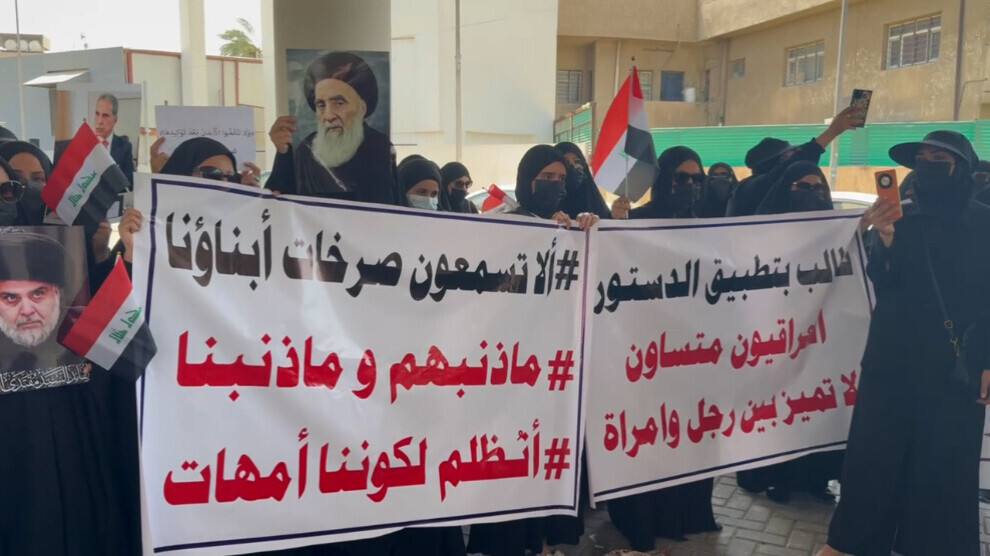
Baghdad — Participants in the protest vigil in front of the Supreme Judicial Council in Baghdad unanimously affirmed the necessity of protecting children's best interests and stopping the unilateral alteration of marriage contracts, stressing that the retroactive application of the Jaafari Code exacerbates mothers' suffering and threatens family stability.
The voices of Iraqi Shiite mothers rang out today, Saturday, July 18, from in front of the Supreme Judicial Council in Baghdad, chanting slogans demanding justice: "Is there no one to support mothers, protect children, and safeguard the Iraqi family?" They called on all people of conscience and all who believe in justice and fairness to stand with this humanitarian cause.
The Best Interests of the Child Above All
Umm Abdullah (R.W.) said that mothers came out in a peaceful demonstration demanding the activation of Paragraph (86) concerning the best interests of the child, affirming that granting custody to the father after formal procedures does not consider the child's best interests, especially since many fathers cannot dedicate time to care due to work commitments.
She added that among their most prominent demands is also the rejection of converting marriage contracts to the Jaafari Code unilaterally, despite the marital relationship having ended years ago. She noted that her ex-husband—who left her while she was pregnant and never even learned their daughter's name—returned after the Code was issued to demand custody of their children, even though she had not remarried to preserve their stability.
She also called for a review of Decision (93) concerning the age of custody, considering that it confuses civil law with religious code provisions, and called on the President of the Supreme Judicial Council and the Prime Minister to respond to the demands of mothers who have continued demonstrating since the Code was issued.
"We Are Not Against the Code"
An affected mother, an engineer with a master's degree named (K.A.), said she separated from her husband in 2019 after only two months of marriage, while she was seven months pregnant. She affirmed that he never asked about his daughter throughout the years and did not even request to see her, before implementing the visitation decision after the Code was enacted in 2025.
She added that her six-year-old daughter did not know her father, and upon meeting him for the first time, she was frightened and said, "This is a thief, not my father." She noted that she raised and cared for her daughter in her family's home.
"My Children Are the Victims"
With a voice choked with tears, Umm Muhammad (H.M.) recounted her suffering, saying she is a mother of three children whose father abandoned them years ago and married another woman. He then converted the marriage contract to the Jaafari Code without her knowledge or consent, even though he is married and has not even bothered to see his children.
She added that she alone bore the responsibility of raising them and has a sick child who needs special care. She asked, "How can a marriage contract that has been in place for 18 years be converted to the Code?" She called for the best interests of the child to be the foundation of all decisions, warning of the psychological effects children may suffer if removed from their mothers, affirming that her children refuse to live with their father because they do not know him.
Mothers' Demands Are Legitimate
Women's rights activist Ansam Salman, President of the "Aysen" Organization for Human Rights and Sustainable Development, said that her participation came in support of the mothers in their protest vigil—the tenth such vigil—appealing to the President of the Supreme Judicial Council to consider their legitimate demands regarding the application of the Jaafari Code.
She added that the mothers are calling for a review of Decision (93), which they consider unjust to them and their children, as well as the rejection of unilateral conversion of marriage contracts, and the non-application of the Jaafari Code to expired contracts. She expressed hope that the Supreme Judicial Council would respond to the mothers' demands, in line with laws and international agreements ratified by Iraq.
Protecting Women's and Children's Rights
Media activist Lina Ali, a defender of women's and children's rights, said that the vigil in front of the Supreme Judicial Council came to support mothers, affirming that it is not the first and will not be the last in demanding their rights. She called for marriage contracts not to be changed except with the consent of both parties, for the child to have the right to choose between parents upon reaching the age of seven, and for the Code not to be applied retroactively but only from the date of its issuance.
She considered that applying it retroactively could exacerbate family problems, calling for a review of the law and amendment of details that she believes affect women's and children's rights.
"The Child's Best Interests Above All Considerations"
One of the affected mothers read a statement on behalf of Iraqi Shiite mothers, affirming that justice and the rule of law are the foundations for building the Iraqi family and protecting society. She noted that the application of certain custody provisions under the amendment to the Personal Status Law No. (1) of 2025 has resulted in effects affecting a number of mothers and their children, as some mothers have lost custody or care of their children under circumstances they believe do not consider the child's best interests.
The statement explained that applying these provisions to mothers without their consent, based on the other party's choice, raises legal and humanitarian problems, especially in cases leading to the separation of the child from their mother without an individual assessment of their social and psychological circumstances.
The statement called for adopting the child's best interests as the fundamental standard in all custody decisions, in line with the Iraqi constitution and legal obligations; reviewing the mechanism of applying the Personal Status Law amendment No. (1) of 2025; and not subjecting any mother to its provisions except based on her free and explicit choice.
It also called on the Supreme Judicial Council to review Decision (93) issued by the Expanded Body and to annul it due to its negative effects on the child and their deprivation of their mother for many years; to ensure that children are not used as a means of pressure or revenge in family disputes; and to open a legal and societal dialogue involving specialists in law, sharia, psychology, sociology, and human rights organizations to reach solutions that achieve justice and preserve the rights of all family members, foremost among them children.
The statement concluded by affirming that Iraqi mothers emphasize that these demands do not target any particular party but stem from a concern to protect the Iraqi family, establish the principles of justice and compassion, and ensure that the child's best interests are the primary consideration in every decision concerning their future.