
US-Iran Escalation Widens the Circle of Confrontation and Threatens Regional Security
A rapidly escalating military confrontation between Washington and Tehran extends from southern Iran to the Strait of Hormuz, amid deaths and injuries, strikes on military sites, and mutual threats warning of a broader regional conflict.
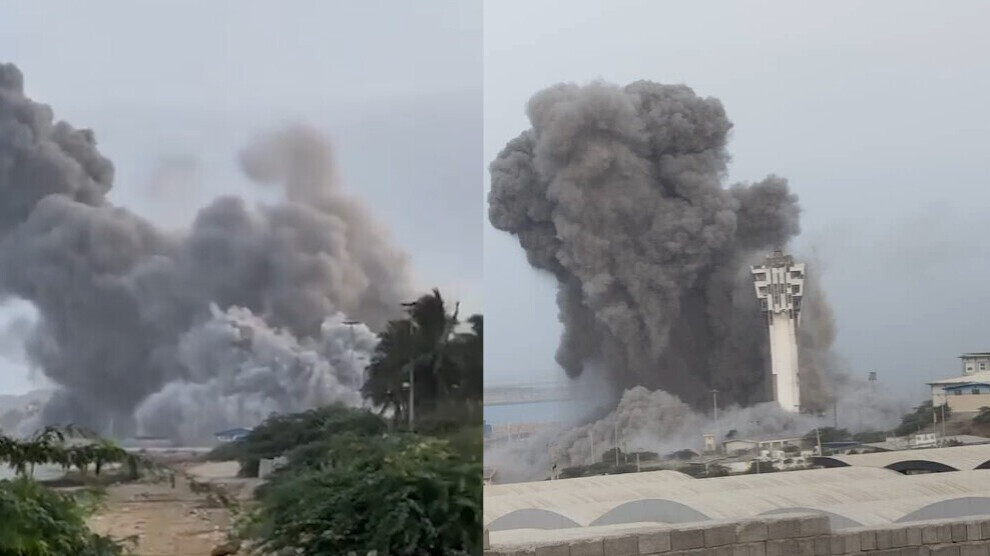
News Center — Amid escalating tension between the United States and the Islamic Republic, the region is entering a new phase of military confrontation, with operations expanding into a wider scope that includes military targets and coastal areas in southern Iran.
These developments come amid warnings of growing humanitarian and security repercussions, with rising fears that the mutual strikes could hit further vital facilities and increase the number of civilian casualties.
The United States launched a new wave of air and naval strikes against military sites in southern Iran, as American officials confirmed that military operations would continue, with the possibility of expanding the scope of targeting to include critical infrastructure should Tehran fail to respond to calls for negotiations.
Dozens Killed, Hundreds Wounded
Iranian government spokeswoman Fatemeh Mohajerani announced that more than 30 civilians were killed in attacks that struck various areas of southern Iran over recent days.
Among the sites targeted was the Sadij area in Hajjiabad district, Hormozgan province, where an environmental protection center and a nearby fodder warehouse were hit. Reports indicated that the environmental guard was not present at the site during the attack, but his two sons and one of their wives were killed in the strike.
The attacks covered a number of southern cities and areas, including Bandar Abbas, Minab, Sirik, Qeshm, Jask, Bushehr, Konarak, Chabahar, Kangan, and Ahvaz, as well as Khondab in Markazi province.
According to reports, most of the strikes focused on military sites belonging to the Islamic Republic, including missile centers, air defense systems, drone bases, and naval facilities. However, the effects of the bombardment extended to residential areas and civilian facilities, causing damage and losses among the local population.
Iranian media had also reported earlier the deaths of eight Iranian army personnel in the south of the country, noting that these losses form part of the official military casualty toll.
War Strikes the Coastal Lifeline
The repercussions of the American strikes were not confined to military sites; their effects also extended to coastal areas whose residents depend primarily on the sea for their livelihood. According to local reports, the attacks caused damage to a number of fishing boats and resulted in deaths and injuries among fishermen, alongside widespread disruption to maritime fishing activity along Iran's southern coasts.
These developments are raising growing fears over the economic and social repercussions of the war for thousands of families tied to the maritime sector, amid disrupted income sources and a decline in trade and fishing activity in areas where seafaring is a fundamental part of residents' lives.
Return of the Naval Blockade and Escalating Pressure on Tehran
Alongside the airstrikes, the United States announced the reimposition of a naval blockade on Iranian ports and coastal areas. US Central Command (CENTCOM) stated that this step aims to protect commercial shipping traffic in the Strait of Hormuz, affirming that American forces remain on maximum alert.
In response, Iran's Revolutionary Guard announced that it had targeted a commercial vessel in the Strait of Hormuz, saying the passage would be closed to Iran-linked ships until further notice. At the same time, reports spoke of missile and drone attacks carried out by the Islamic Republic against passing ships, in addition to targets in Jordan, Bahrain, and Kuwait.
The American president said military operations would continue until an order was issued to halt them, warning that if the Islamic Republic refused to enter negotiations, power plants and bridges — and, at later stages, Iranian energy facilities — would be among the potential targets of attacks. He also accused Tehran of carrying out deliberate attacks against commercial vessels and threatening the security of maritime navigation.
Mutual Attacks and Rising Regional Fears
Official Iranian media reported that the Revolutionary Guard had carried out missile and drone attacks on American military bases in Jordan, Bahrain, and Kuwait. Reports also spoke of attacks on oil tankers and commercial vessels in the Sea of Oman and the Strait of Hormuz, raising growing concerns over the security of one of the world's most important energy transport routes.
In the same context, a missile attack carried out by the Houthis in Yemen on King Khalid Air Base in Riyadh, alongside the expansion of mutual attacks across different areas of the region, has shifted the crisis from a direct confrontation between Tehran and Washington to a broader regional scale.
As the exchange of attacks continues, the full human and material toll on both sides remains unclear. However, the expanding scope of military operations, the threat of targeting critical infrastructure, the disruption of maritime security, and the spread of the confrontation's repercussions to countries in the region are all deepening fears that the crisis could enter a wider and more dangerous phase.