
Tunisians Protest Against Deteriorating Living Conditions and Repression
Protesters from Tunisa’s ‘Nafs’ movement condemned worsening living conditions and repression, calling for water, Electricity, and prison death inquiries.
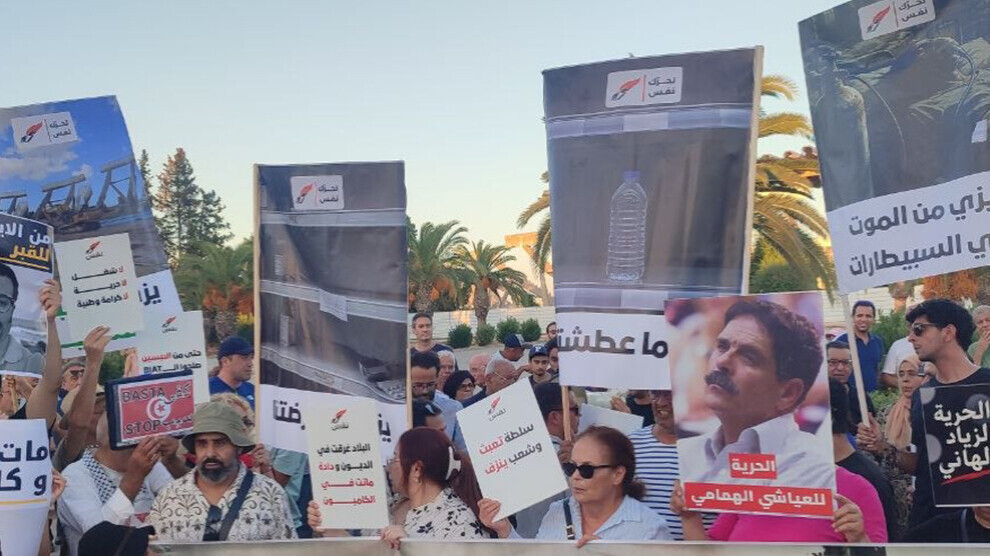
Tunisia_ Participants in the protest called for revealing the truth behind prison deaths and ensuring the provision of their basic rights to a dignified life, stressing the need to protect freedoms and release political prisoners amid escalating social tension in Tunisia.
The ‘Nafs’ movemet organized a protest vigil yesterday, Saturday, September 5, in front of the Olympic Stadium in El Menzah, in the Capital Tunis. Protesters demanded the provision of the most basic elements of a dignified life for the Tunisian people, 15 years after a revolution that has left only its name. Voices were raised during the vigil, with the participation of civil society components and independent activists, chanting slogans reflecting the scale of popular anger.
Protesters chanted slogans denouncing escalating security and political repression, expressing their rejection of the deteriorating living conditions through demands for the right to water, electricity, and a dignified life.
The protests also focused on the rights and humanitarian dimension, with voices demanding the full disclosure of the circumstances surrounding prison deaths, alongside calls for the release of all political prisoners and journalists, denouncing what they considered the continuation of policies of marginalization and repression.
Civil society movements in Tunisia were not limited to social and livelihood demands but also denounced the systematic restriction of public and individual freedoms, particularly freedom of expression and the press, through the use of a legal and punitive arsenal, including Decree 54 and various other decrees that have contributed to restricting public space and stifling free speech in Tunisia.
Civil society activist Najia Al‑Warghi affirmed that yesterday's march was spontaneous and representative of various components of civil society, expressing rejection of the catastrophic reality Tunisians are living. She pointed out that the country has reached the brink of an unprecedented crisis since independence, marked by water cuts and recurrent power outages across all areas, to the point where citizens cannot find potable water in summer or cool it.
In her testimony on what she described as the "catastrophic situation" inside prisons, she explained that a number of detainees are dying of thirst under extreme heat simply for asking for a drink of water. She criticized what she considered a cover‑up by the Ministry of Health and the concealment of actual death figures, saying: "The announced figure of 28 deaths does not reflect reality; only hospitals can provide the true toll."
She concluded by stressing that the crisis has extended beyond prison walls to the streets, warning of the dangerous situation after she personally witnessed citizens fainting in the streets this week due to the lack of drinking water.
The Movement Reflects Street Anger
Lawyer Mounia Ibrahim affirmed that participation in the "Nafs" movement is part of a series of field protests in response to unprecedented political deadlock and escalating repression and arbitrary arrests targeting politicians, bloggers, journalists, and businessmen.
She pointed out that this movement reflects street anger over severe economic and social deterioration, as Tunisians suffer from suffocating living crises that reach the point of being unable to provide drinking water for families and children, in addition to recorded deaths in prisons due to thirst and high temperatures, as confirmed by organizations such as the Young Doctors Organization and the Tunisian League for the Defense of Human Rights.
She noted that the choice of the Olympic Stadium in El Menzah as the protest site came because it symbolizes monumental failure and the absence of projects, questioning the authorities' ability to manage the country's affairs if they cannot maintain a sports stadium for over three years, while warning of the repercussions of the absence of economic, social, and developmental visions.
During the vigil, the family of the late young man Ala, who died in prison after being detained for four months without interrogation or confrontation, attended, even though he could have been investigated while free. His case became a glaring example of what they described as serious violations.
On the judicial and political front, Mounia Ibrahim addressed the so‑called "conspiracy case," denouncing the political use of the judiciary after a judge was appointed to the Court of Cassation during the summer holiday to issue a decision rejecting the appeal and closing the case, resulting in harsh sentences against opposition figures simply for exercising their constitutional and legal right to peaceful opposition.
She concluded by affirming that families and defense bodies will continue to resist and demand the immediate release of all political prisoners, rejecting the Tunisian citizen being a victim and sacrifice for the current authorities' failure.
Tunisia is experiencing a deep structural crisis and escalating social and political turmoil, characterized by an unprecedented state of popular anger and deadlock. Current policies have led to near‑total paralysis in a number of vital sectors, manifested in suffocating crises affecting the most basic elements of life, such as recurrent and successive cuts in drinking water and electricity, coinciding with a sharp decline in purchasing power and rising living costs.
This critical situation is not limited to the livelihood and economic aspects but has been accompanied by a serious regression in public and individual freedoms. The country is witnessing systematic restrictions on freedom of expression and the press through the use of a legal and punitive arsenal that has constrained civic and political space, amid growing arrests and prosecution of activists, politicians, and journalists—most recently journalist Mohamed Al‑Yousfi. This bleak scene has reinforced a general sense of losing direction and the absence of radical solutions, prompting civil society forces, organizations, and independent figures to raise their voices through continuous field movements to demand the rescue of the country, an end to marginalization policies, the release of political prisoners, and a return to a path that guarantees Tunisian citizens their dignity and their fundamental right to a just and democratic environment.