
The Middle East Crisis and the Democratic Intergration Solution
BRIVAN ZILAN
A new phase has begun based on reviving the Kurdish-Tukish alliance, which has historically been a factor in achieving strategic developments, coinciding with the February 27 statement. The significance of this phase is not limited to Turkey alone; it carries the potential to influence the overall development taking place in the region.
In the face of the "divide, fragment, and rule" policies pursued by the British toward the region, leader Abdullah Öcalan, through the perspective of democratic integration, proposed a new way out of the crisis. He also presented, for Turkey, proposals to resolve the chaos the region is witnessing, alongside assessments related to the "National Pact."
After leader Öcalan stated, in the face of the long‑standing war, that he had been searching for years for a negotiating partner, he pushed his recent proposal on the conditions for a solution to their furthest limits. Through his management of the dialectic of negotiation and struggle in the best possible way, he brought the process to where it stands today.
In this way, he sought to end the Kurdish‑Turkish conflict, as well as to open a new path in the face of the ongoing violent war in the region. Finally, with the Turkish Grand National Assembly passing a law called, despite its shortcomings, the "Framework Law," the Kurdish issue was moved for the first time "from the execution platform to the negotiation table." Through this step, the state, the revolution, and socialism were brought together around one table.
The Framework Law has been described in Kurdish circles as a precursor to the "Radical Law" that will come later. In order to put the law into practice, the Freedom Movement, from the beginning and through its statements, affirmed the necessity of leader Öcalan directly managing the process.
Although leader Öcalan is described in public opinion as the coordinator of the "Disarmament and Strategy Committee," no precise official clarification has yet been issued by official bodies on this matter.
At a time when the process is marked by this degree of sensitivity and importance, the failure to reflect leader Öcalan's views personally to the public, the denial of regular meetings with his family and lawyers, and the prevention of meetings with various parties and circles—all of these raise concern in Kurdish circles.
Attacks against leader Öcalan based on minutes of meetings allegedly held in İmralı have continued.
The fundamental condition for the proper functioning of the process is ensuring leader Öcalan's physical freedom and securing the conditions that allow him to live and work freely. For the process to advance stably and gain a dynamic trajectory, leader Öcalan should address the public himself and remain in continuous dialogue with relevant parties. However, the state still wants to keep him in an illegal status.
Without progress in this direction, the implementation of the Framework Law as required remains doubtful. Although the issue of the "right to hope" for leader Öcalan was raised by Devlet Bahçeli at the beginning of the process, even on this matter no step has been taken regarding the rulings of the European Court of Human Rights, and no positive development can be spoken of unless this approach is corrected.
Among the issues discussed within the framework of the Framework Law is the process of the return of PKK forces to Turkey. The Freedom Movement has repeatedly affirmed the necessity of leader Öcalan's involvement in the process, that the return should be collective and organized rather than individual, and that the groups leaving should be directed toward political struggle arenas, in order to ensure that the returns take place on a sound basis.
In these matters as well, various forms of manipulation are being resorted to, and mainstream media continues to raise debates suggesting that the law will be limited to individual requests, that it will not include everyone, that returnees will be gathered in camps, and that there is discussion of imposing a ban on political activity on those who leave.
In this formula, the Framework Law is currently being addressed solely on the basis of disarmament. For this reason, the use of "terrorism" rhetoric in the law, the absence of any assessment related to the resolution of the Kurdish issue, the lack of any arrangements regarding democratic steps, and the failure to clearly and concretely express leader Öcalan's status—all of these are matters criticized in the law.
It is clear that the remaining shortcomings will be overcome through the organized struggle of the people of Kurdistan and the building of a democratic society.
The Kurdistan Freedom Movement has consistently maintained its position of being the left‑socialist wing of the dual‑pillared state, and through its struggle to transform the state and endow it with democratic characteristics—the path to which also passes through a strong social struggle. Reaching and uniting all segments of society within a common struggle path would also push toward democratic steps.
Regional Developments and Reasons for Accelerating the Law's Enactment
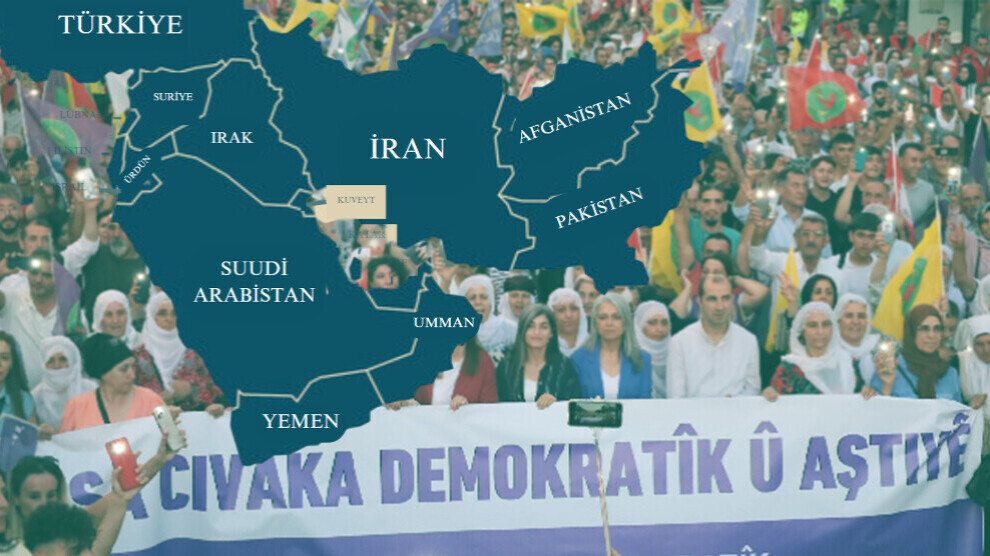
The primary factor behind the rapid enactment of the law within the process is regional developments. The attacks by the United States and Israel on Iran and their effects on all countries in the region continue, and relevant officials continue to issue statements about the possibility of these attacks escalating.
Since the intervention against Iran has not yet been completed, the reordering of the region has not reached a final outcome. For this reason, every power, each according to its capabilities, is working to activate its regional plans.
The visible aspects of these plans include Israeli attacks on Syria, operations carried out by Iran against Middle Eastern countries under the guise of "retaliatory response," discussions regarding bringing armed forces in Iraq under one umbrella, the Mecca Agreement signed between Turkey, Pakistan, and Saudi Arabia, along with efforts to establish the "David Corridor" within the framework of the previously signed Abraham Accords led by Israel.
The essence of the chaos lies in the declared and secret calculations circulating between Israel, Turkey, and Iran, within the framework of these powers' efforts to become the dominant force in the region.
It is also known that all imperialist powers support Israel, and in this context, they assign roles to regional countries. One of the reasons for Turkey's meetings with leader Öcalan is also its desire to emerge from the regional war with the least possible losses.
What is happening in the region is a power struggle, and once again, women, children, and peoples are being turned into victims of this war. It also appears that war and chaos will not end in the short term. This war, which will center around Iran, could at any moment extend to other areas. At a time when war, attacks, and armament agendas are intensifying to this extent in the region, the PKK's resolution of itself and its transition from an armed struggle strategy to a democratic struggle strategy represents a major transformation. This strategy does not only determine a path of struggle for the party itself.
Within the framework of the democratic integration project, an attempt is being made to resolve the problems of Kurds with the four countries in the region. Leader Öcalan himself is managing the process being developed with Turkey, but some difficulties are emerging regarding the other countries.
Due to the ongoing war, Iran is one of the most prominent areas of difficulty. Neither the rigid Shiite regime nor American imperialism can provide a solution to the problems of the peoples in Iran. Unless Iran transforms into democracy from within, it will not be able to achieve a serious breakthrough.
In this regard, if Iran develops a solution based on its peoples rich in diversity and their plurality of beliefs, it may be able to emerge from the war with gains. However, regime changes carried out by external forces do not represent salvation for Iran's peoples; the assessments of the people during the war period and their attitudes toward Reza Pahlavi, who was promoted as an alternative, have clearly demonstrated that.
Although Iran is at the center of all these attacks, it continues to direct its attacks toward its own people. People are being arrested on a wide scale, detainees are being executed, military attacks against Kurdish parties continue, civilians are being killed, and women are being left as if they have no breath.
In the face of such a volume of attacks, keeping the issue of the disarmament of the Free Life Party of Kurdistan (PJAK) constantly on the agenda by Turkey does not serve the interests of the peoples. In an environment where people are being killed, no conscience or human understanding can accept laying down arms.
If the Iranian regime also ends its internal pressure on the people and joins the democratic integration project with the Kurds, then struggle strategies can be discussed. But at this stage, as PJAK officials have also stated, such proposals do not apply to Eastern Kurdistan.
Syria and Democratic Integration
Official statements have been issued stating that the democratic integration of the Syrian Democratic Forces (QSD) in Syria has been completed, but some issues remain in crisis.
Although some discussions have taken place within the framework of the integration of the Women's Protection Units (YPJ), there are unresolved matters. It is also said that mother‑tongue education will be restricted to only three hours.
Although the Kurds have achieved some gains within the framework of integration, they are still not seen as a fundamental component of Syria. Repressive practices against different beliefs and women continue, and attacks in this direction persist.
The practices imposed by a state that has not itself transformed into democracy—on Kurds, particularly regarding mother‑tongue education and women's gains—do not represent integration but rather assimilation. These approaches are also causing extreme discontent among the people.
Rojava is one of the founding elements of a democratic Syria, and it has important experiences and expertise in preparing a constitution for a democratic Syria, and it can play a role in this field. Although negotiations continue, the foundation is struggle.
Iraq and the Kurdistan Region
Intensive discussions are also taking place regarding Iraq and the Kurdistan Region. In Iraq, October is being targeted for the integration of all armed forces into the army. The integration of the Sinjar Resistance Units‑Women's Resistance Units (YBŞ‑YJŞ), as the legitimate self‑defense force of the Yazidi people, is also among the issues under discussion.
There is the reality of a people who have endured, over many years, decrees and massacres. The council formed by this people through their own will, along with their military forces, is the most legitimate force in the region. The fundamental solution lies in recognizing the will of the Sinjar People's Council, which represents local democracy in the region, and formalizing the self‑defense forces.
The Turkish state has positions that obstruct this regarding Sinjar, but the primary party concerned with this file is the Iraqi state, which should assume its responsibilities.
In addition, the situation of the residents of Makhmour, located within Iraqi borders, has also entered the circle of discussion with this process. The issue of the collective and organized return of the population to North Kurdistan has been consistently raised since the beginning of the process.
It is also known that the lands they left have been looted, their villages destroyed, the threats of village guards continue, and their property has been confiscated. No dignified return can be spoken of unless all these problems are resolved.
The Kurdistan Region and the Political Crisis
In the Kurdistan Region, although a long time has passed since the elections, they have not yet been able to form a government. The political system here has also reached a dead end due to insistence on a dynastic family system, while the demands of society in this region are ignored.
The formation of a democratic unity government in the region is the fundamental solution to the existing social and political problems. Although there are efforts by democratic forces in this direction, it cannot be said that sufficient results have yet been achieved.
Rates of violence against women and femicide in the Kurdistan Region are also rising sharply, and all areas through which women can express themselves politically and socially are being abolished.
Among the fundamental solutions to addressing all existing problems is the development of democratic national unity, and responsibility falls on every formation working in this direction. Women can play a leading role in this field.
Women Facing the Region's Crises
The developments in the region affect women more than others. Women in wars face forced displacement, hunger, and state violence, and states, through their corrupt structures, become the primary agents of violence against women.
The murders of Narin Güran, Klistan Doko, and Rojin Kabayış in Turkey have shown everyone the extent of the corruption of state institutions and their employees, and how they have become accomplices in crimes related to femicide.
The developments in the region affect women more than others. Women face, under the weight of both state violence and patriarchal violence, a widespread killing policy that targets them dangerously. There are also mentalities of negation and abolition targeting women's gains. Leader Abdullah Öcalan, in the context of resolving women's issues, emphasized the need to establish a women's law.
For this reason, he insists in the ongoing process that women also be present at the negotiation table. It is important that there be women's representations in the committees that have been formed, that women's movements participate in the process as an organized force, and that bodies be formed to monitor and follow up on the process. The primary factor that will lead the process to success is the organized struggle of women.