
"Palestinian Women Journalists Speak" conference documents the suffering of female journalists
The "Palestinian Women Journalists Speak" conference documented female journalists' wartime experiences under genocide, highlighting their suffering and demands for protection, accountability, and support to continue working.
NAGHAM KARAJA
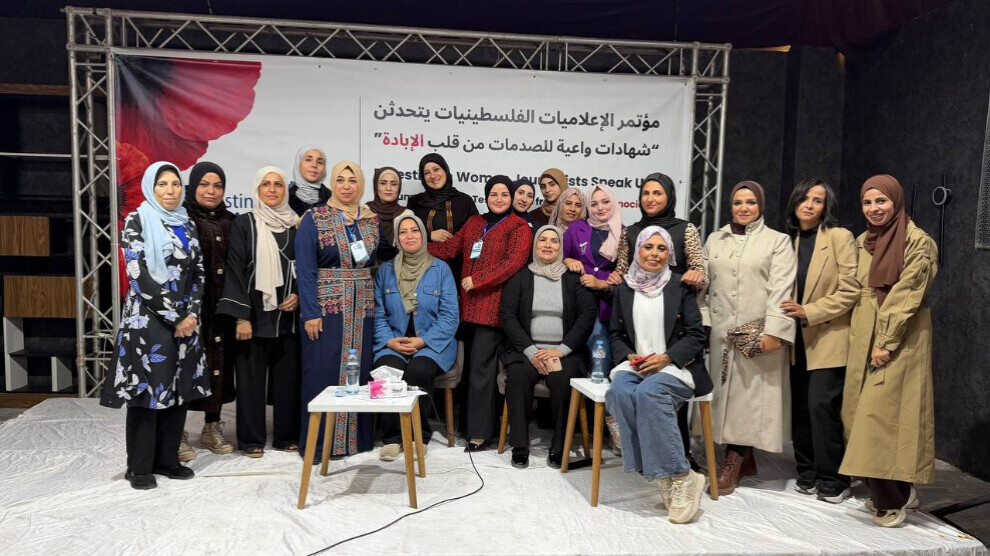
PALESTINE — The "Palestinian Women Journalists Speak" conference, under the title "Conscious Testimonies of Trauma from the Heart of Genocide," formed a space for recalling testimonies and documenting what female journalists were subjected to. The interventions of the participants revealed that overcoming the effects of war is not achieved merely by listening to their suffering, but requires providing the conditions of life and work, and guaranteeing protection and accountability, so that the resilience of female journalists does not turn into an additional burden they bear alone.
Amid the repercussions of the Israeli genocide war on the Gaza Strip, and the displacement, loss, and professional and psychological risks it left behind, the Filastiniyat Foundation organized its annual conference, "Palestinian Women Journalists Speak," on November 11 and 12 of the current month under the title "Conscious Testimonies of Trauma from the Heart of Genocide," with the participation of female journalists, researchers, and activists from the Gaza Strip, the West Bank, and the world, to document the experiences of Palestinian female journalists during the war, shed light on its psychological, social, and professional effects, and the needs they still face to continue their work.
The conference came after a three-year hiatus due to the war, reopening a space for female journalists to talk about their experiences — not only as transmitters and witnesses of events, but as women, mothers, breadwinners, and family members who lived through the conditions of genocide, displacement, and loss while continuing to cover its daily details.
Female journalists' experiences from the heart of war
Wafa Abdel Rahman, director of the Filastiniyat Foundation, opened the conference by saying: "Organizing the eighth annual 'Palestinian Women Journalists Speak' conference comes within the framework of providing a space for Palestinian female journalists to narrate their experiences and document what they lived through during the Israeli genocide war, and to shed light on the burdens they carried at the humanitarian, psychological, and professional levels, amid displacement, the loss of family members, and the destruction of the foundations of life and work."
She stressed the importance of these testimonies reaching the world, as documentation of the experience of female journalists who continued to perform their media mission despite the dangers surrounding them. She added that the conference is not limited to listening to testimonies, but opens discussion about the needs of female journalists and ways to support them, especially with the continued effects of the war on their lives and their ability to work, highlighting the need for support that goes beyond the psychological aspect.
Double standards in international media's treatment of Gaza's victims
On the sidelines of the conference, journalist Hanan Al-Rifi stressed to our agency that the conference drew its importance from the live testimonies presented by female journalists about their experiences during the genocide war, affirming that their suffering was not limited to the risks of press coverage, but extended to the details of daily life.
She added that Palestinian female journalists proved their ability to continue performing their mission despite these circumstances, but they have become in need of a serious stance from international, Arab, and press institutions that translates solidarity with them into actual support that responds to their needs and preserves their ability to continue working and living in dignity.
The importance of psychological support for journalists
For her part, Niveen Abdel Hadi, director of the Mental Health Department at the Palestinian Red Crescent Society in the Gaza Strip, presented a working paper titled "Psychological Support Protocols and Their Importance in Working with Male and Female Journalists," in which she addressed the society's experience in providing psychological support to media workers during the war.
She explained that the society worked to implement programs to support male and female journalists in the Gaza Strip, despite the exceptional circumstances that accompanied the genocide and the destruction, killing, and targeting it witnessed, affirming the importance of psychological interventions that take into account the nature of the traumatic experiences that media workers were exposed to, and the pressures that accompanied their continued coverage.
Renewing the pledge to colleagues of the journalistic mission
For her part, journalist Mahi Adwan pointed out that the conference did not overlook mentioning the male and female journalists who lost their lives during the war, recalling names including journalists Mariam Abu Daqqa and Heba Al-Abadla, affirming that her colleagues who lost their lives in the pursuit of truth will remain present in the memory of female journalists and in the work they continue to perform.
She called on the institutions organizing the conference to pay special attention to female journalists and provide them with material, psychological, and moral support, explaining that many female journalists have become the sole breadwinners for their families and children, and face doubled responsibilities amid the loss of sources of income and the deterioration of living conditions.
From testimonies to recommendations
The importance of the conference was not limited to documenting the personal experiences of female journalists; it also raised a fundamental question about the responsibility of media, rights, and humanitarian institutions toward women who continued journalistic work amid genocide, and whether current forms of solidarity and support actually respond to their needs.
At the conclusion of the discussions, a set of demands and recommendations emerged, foremost among them the demand to investigate war crimes and Israeli violations committed against male and female journalists in the Gaza Strip, and to hold those responsible accountable before the competent judicial authorities.
The demands included providing occupational safety equipment, filming, documentation, and communication tools, compensating female journalists for equipment they lost during the war, and launching economic and professional support programs that take into account the situations of independent female journalists, piece-rate workers, displaced women, widows, divorcees, and breadwinners for their families.
The participants also stressed the need to develop media institutions' policies in a way that guarantees the protection of female journalists, takes into account their family and humanitarian responsibilities, and enhances the presence of the Palestinian narrative in international media.