
Leader Öcalan Presents a New vision for peace and Democriatic Sociialism.
In an analytical message to the International “Peace and Democratic Society” Conference, Öcalan outlined a vision to revive socialism as a living force and chart a path toward peace and a democratic society
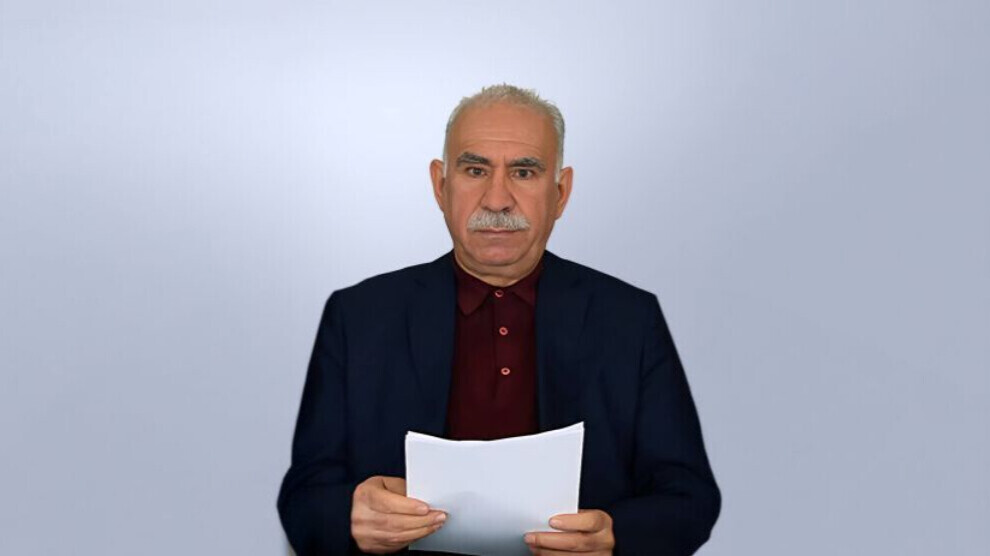
News Center — The Equality and Peoples’ Democracy Party (DEM) in Istanbul has launched the International Peace and Democratic Society Conference, which discusses the experience of leader Abdullah Öcalan in issuing the call for “Peace and a Democratic Society” on February 27, alongside the presentation and discussion of similar global experiences.
A large number of international figures and delegations are participating in the conference, from the Basque Country and South Africa, through the UK’s Sinn Féin National Party, to Kazakhstan and Belgium. They are attending as speakers and participants in its sessions, making the conference a global platform for the exchange of experiences and visions on issues of peace and democracy.
Veysi Aktaş, who was recently released from İmralı Island Prison, delivered a speech at the opening session of the conference, in which he conveyed a message from leader Abdullah Öcalan on peace and the building of a democratic society, emphasizing the importance of this vision at the present stage.
Leader Abdullah Öcalan sent an analytical message to the conference entitled “Let Us Reclaim Socialism Through Building Peace and a Democratic Society.” It is an in-depth theoretical study spanning four pages, presenting his vision on the paths to achieving peace and consolidating the foundations of a democratic society, providing an intellectual framework for the discussions taking place at the conference.
Socialism as a Living Social Force
The message states:
“Dear intellectuals, comrades, honorable delegates, and all those who still believe in the possibility of achieving socialism: from İmralı Island, where I have spent twenty-six years under isolation conditions, I address you at a new stage in which negotiations with the government over the Kurdish issue have resumed, in pursuit of peace and the building of a democratic society in Turkey. My participation today in the International Peace and Democratic Society Conference to speak about rebuilding socialism carries great value and meaning. We, the Kurds, after a struggle that lasted fifty-two years through the Kurdistan Workers’ Party (PKK), have completed one phase and entered a new one titled the re-establishment of the Democratic Republic and the building of a firmly rooted democratic society.”
Öcalan added in his analytical text:
“The party succeeded in consolidating the national existence of the Kurdish people and fulfilling its historical mission, while at the same time exposing the impasse of state-centered socialism tied to the nation-state. The model of socialism that emerged in the twentieth century appeared as an incomplete revolutionary movement that failed to offer a new alternative. With the arrival of the 1990s, at a time when most forces turned away from socialism, I declared that persistence in socialism is, in essence, persistence in humanity, and I devoted my life to reviving this hope. Despite immense sacrifices, the struggle turned into a rich legacy of theoretical critique and practical experience. Correctly comprehending this legacy means rescuing socialism from being merely a memory and transforming it into a living social force pulsing within the conscience of the people. The socialist tradition in history should be viewed as a guiding legacy for building peace and a democratic society, and the path to that passes through fulfilling internationalist duties at both the theoretical and practical levels.”
He further noted:
“Although utopian and Marxist socialists since the nineteenth century directed extensive criticism at the dominant capitalist system, they failed to formulate a successful practical path that achieved tangible results. Capitalism today is no longer merely in crisis; it has turned into a disease that threatens the very existence of humanity. The monopoly of violence in the form of the nation-state is a fundamental factor in this collapse. Capitalism cannot be explained solely by economic causes, nor can the failure of socialist currents be reduced merely to capitalist pressures, as historical and contemporary mistakes played a decisive role in this decline.”
Öcalan stressed:
“My criticisms of Marxism must be understood correctly; I do not hold Marx personally responsible. His era was not as exposed as ours, there was no ecological crisis, and capitalism was in its phase of ascent. Nevertheless, Marx was a thinker with great self-confidence who continuously revised his ideas. He addressed the issue of women’s liberation, but did so superficially and failed to grasp its depth, assuming that overcoming economic exploitation would automatically end the oppression of women. His attempt to interpret social history solely through the concept of class, and his inability to adequately analyze the state and the nation-state, led to grave consequences. Despite all these observations, I maintain great respect for Marx’s efforts, do not doubt his intentions, and regard Marxism as separate from his person. What we socialists do when we critique Marxism and real socialism on certain fundamental issues is nothing more than the practice of self-criticism.”
He called on anti-systemic forces to reformulate historical materialism in line with the reality of human society:
“It is necessary to recognize that capitalism did not suddenly emerge in the sixteenth century; rather, its roots extend back into the civilizational process of Mesopotamia ten to twelve thousand years ago. Sites such as Göbekli Tepe and Karahan Tepe reveal these historical beginnings. From this perspective, describing the prevailing civilizational system as a ‘class-based system that kills society’ is most accurate. Archaeological and anthropological discoveries confirm that male hunter classes developed killing techniques through which they suppressed and enslaved female-centered tribal communities. This division represents the deepest rupture in human history and constitutes a major counter-revolution that shaped the subsequent course of civilization.”
He pointed out that analyzing capitalism from a historical perspective offers broader insight and new horizons:
“This system not only fuels contradictions within society but also threatens the existence of humanity as a whole by developing chemical and nuclear weapons capable of annihilating the planet, polluting the climate, and plundering the wealth of nature above and below the earth, leading to comprehensive environmental destruction. From this reality, presenting a new reading of capitalism becomes a major humanitarian task and one of the foremost internationalist duties of our era.”
The analytical text further explained that reading the history of the oppressed from the perspective of the commune, as a primordial form of self-defense before the emergence of classes:
“Provides a deeper understanding of humanity’s trajectory. Primitive tribes can be seen as the beginning of the commune, and this historical perspective then extends to the proletariat or all oppressed groups in our time. Thus, we say that history is not limited solely to class struggle, though it includes it, but is essentially a process of interaction and struggle between communal development and counter-communal development—a course extending nearly thirty thousand years.”
“Democratic Socialism Toward Building a Free and Just Society”
Öcalan expressed confidence that the conference would achieve its objectives:
“Based on the theoretical analyses I have presented, the way will open for profound discussions that contribute to shaping a new political program and a different vision of organization. In this context, the materialist dialectical method remains fundamental, but it is necessary to transcend certain exaggerations of classical dialectics. Contradictions are not opposing poles seeking to annihilate one another; they are socially interdependent phenomena. The commune cannot exist without the state, nor can the proletariat exist without the bourgeoisie. Therefore, contradiction should be approached with a transformative logic and a historical perspective that opens new horizons, rather than with a logic of negation.”
He added:
“Scientific developments confirm that the dialectical method, so long as it is not absolutized, remains an effective tool in social analysis. Hence, updating the commune–state dialectic and the class–state dialectic becomes necessary. The failure of real socialism in the twentieth century stemmed from a misreading of this historical dialectic; when statist socialism seized the state, it ultimately ended in defeat before it. Likewise, linking the right of nations to self-determination to the nation-state led to subordination within bourgeois political boundaries, while the concept of a ‘proletarian nation-state’ was merely a reproduction of statist mentality without offering a genuine alternative.”
He clarified:
“State-based, nation-state socialism is doomed to failure, whereas societal democratic socialism is what leads to success. Today, the time has come to move toward democratic liberation on this basis. On this path, I believe in our ability to rebuild through the perspective of the Democratic Republic and the Democratic Nation, relying on a societal model grounded in women’s freedom, ecology, and democracy. This awareness has granted our movement intellectual and political renewal, organizational vitality, and deep popular roots, enabling it to reach a socialist program capable of responding to the demands of this century.”
He criticized the reshaping of the relationship between democratic socialism and the state within the framework of the peace and solution process:
“I define this relationship as a path toward democracy. The concept of the Democratic Republic rests on the notion that the state is not a force above society with a divine character, but rather a structure that operates according to a democratic contract with society. Through the strategy of democratic politics, change and transformation can be realized within the state, and society can be rebuilt on firm democratic foundations.”
He explained:
“Anchoring this strategy in law constitutes a permanent foundation for peace, as law becomes the guarantee of the democratic relationship between state and society and a balancing mechanism that prevents violence and opens the path to peaceful solutions. Law also assumes an institutional role in establishing the legitimacy of the Democratic Republic, consolidating it, and rebuilding the social system on more just and stable foundations.”
Öcalan highlighted one of the most important strategies he proposed in the course of struggle:
“The concept of democratic integration and the restructuring of law associated with it stands out. In this context, law is reshaped in favor of society, based on individual, universal, and collective rights standards. The Law of Democratic Integration is founded on three fundamental principles: the Law of the Free Citizen, the Law of Peace and Democratic Society, and the Laws of Freedom. These principles constitute the pillars that guarantee the re-establishment of the relationship between state and society on just, democratic, and sustainable foundations.”
He concluded his analytical text by stating that the Law of Democratic Integration represents a fundamental step in transforming the state into a normative state while simultaneously granting society the ability to institutionalize its gains and entrench freedom:
“The call for ‘Peace and a Democratic Society’ is, at its core, a dialogical path. In the Middle East, with its ethnic, religious, and sectarian diversity, much can be achieved through dialogue and democratic negotiations. I believe that true socialism is not built through violent revolution, but through a positive method of construction and existence, embodied in forms of democratic dialogue. It is difficult to imagine building socialism or ensuring its continuity without a comprehensive and profound democratic dialogue. Lenin affirmed that ‘socialism cannot be built without comprehensive and advanced democracy.’ Based on this conviction, I wish our meeting success and extend my permanent greetings and comradeship, with sincere affection.