
KJAR: The struggle against violence cannot be confined to a specific date
Eastern Kurdistan's Free Women's System urged women to join resistance, saying the struggle can't be limited to one date yearly—they confront violence daily until no woman dies merely for being a woman.
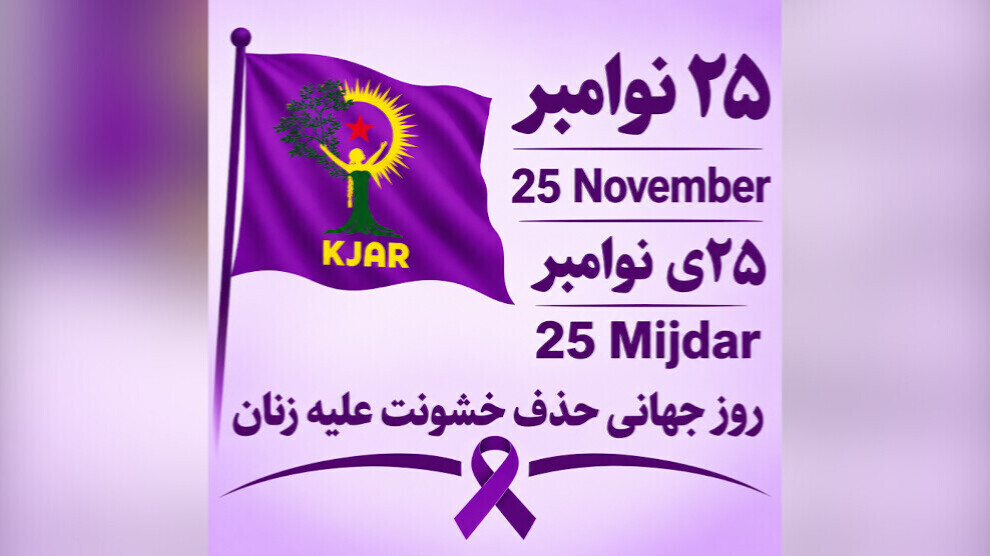
NEWS CENTER — The Free Women's System in Eastern Kurdistan (KJAR) affirmed that invisible violence is worsening due to living crises, economic pressures, and the absence of protective and deterrent laws, and contributes to entrenching marginalization, excluding women, and stripping them of their independence, as well as paving the ground that leads to the emergence of forms of violence.
The Free Women's System in Eastern Kurdistan (KJAR) issued a statement today, Saturday, November 14, ahead of the International Day for the Elimination of Violence against Women, which falls on November 25, in which it affirmed that the "hidden violence" to which women in Iran are subjected continues in multiple forms, most notably systematic economic deprivation, institutional legal discrimination, psychological and cultural pressures exercised under the pretext of "protecting honor," in addition to burdening victims with responsibility for the violence they are subjected to.
Escalation of repression amid political crises and wars
The text of the statement read: "With the approach of the International Day for the Elimination of Violence against Women, the crises and political turmoil witnessed in the region dominate the general scene, including the atmosphere of war between the United States, Israel, and Iran. In such sensitive phases, the greatest danger lies in the marginalization of the internal war waged by the regime against society, especially the escalation of structural violence practiced against women, and its removal from the circle of public attention."
It explained that historical experiences have proven that the repression system exploits external crises to strengthen its grip and tighten its control over the interior. "Over the past year, the security and judicial apparatuses affiliated with the repression system continued their activities at an unprecedented pace. Data indicate a wide wave of enforced disappearances in Kurdistan, Baluchistan, and other areas of the country, where multiple practices continue, starting with arbitrary arrests carried out without prior notice, passing through the transfer of detainees to unknown security detention centers, and reaching the issuance and widespread execution of death sentences."
Through the statement, the System pointed to the report of the Iran Human Rights Organization, which revealed the execution of at least 528 people during the first eight months of 2026 alone. This shocking figure reveals that intimidation has become one of the basic tools on which the regime relies to contain popular discontent and control the state of societal resentment.
Society slides into a multifaceted spiral of violence
The statement explained that alongside state violence, society faces an unprecedented wave of femicide crimes, as well as killings committed within tribes and families. Data indicate that this violence claims the life of a woman in Iran daily or once every few days.
The statement added that "legal loopholes, the lenient position of the judicial system toward perpetrators of crimes related to so-called 'honor,' alongside the reproduction of the ruling structure of patriarchal and masculine ideology, are all factors that open the way for killers and grant them protection and impunity," affirming that a society that does not safeguard women's right to life and freedom, and does not provide them with the necessary protection, is bound to slide into a spiral of multifaceted and multidimensional violence.
The widening scope of hidden violence
On the other hand, the Free Women's System affirmed that the hidden violence practiced against women in Iran continues, through systematic economic deprivation, institutional legal discrimination, and forms of psychological and cultural pressure imposed under the pretext of "protecting honor," in addition to practices of blaming victims and holding them responsible for what they are subjected to. "This invisible form of violence, whose severity is exacerbated by living crises and the absence of laws that provide protection and deter perpetrators of violations, entrenches women's marginalization and stamps their exclusion to a secondary rank in daily life with a character of habit and social acceptance, wresting from them their right to independence and self-determination, and paving the way for the explosion of more explicit and destructive forms of violence."
The System explained that despite the overlap and multiplicity of forms of repression, prisons in the country have turned into basic centers of resistance, the pursuit of justice, and the enhancement of awareness. "The resilience of women like Zainab Jalalian, Warishe Moradi, and Pakhshan Azizi, alongside the determination of women like Zahra Pirdahqan and Sara Rashidi, who were targeted by enforced disappearance and security repression, confirms that prison walls could not silence the voice of the struggle for equality. Rather, this resilience contributed to turning the prison into an arena where political resistance, social struggle, and the demand for justice intersect, making it an advanced position in confronting the repression system."
The struggle against violence every day of the year
The statement added that "the struggle waged by women over these years, and the sacrifices they made, contributed to establishing irreversible gains. Among the most prominent manifestations of this struggle is the unification of the demands of the women's movement with the protests of workers, teachers, students, components, and oppressed minorities, in order to wage a joint struggle against structural and economic violence and violence based on so-called 'honor,' keeping the files of enforced disappearance, executions, and femicide constantly present in the circle of public attention, and preventing the news of repression from being obliterated or forgotten under the weight of military and political crises, shedding light on the resistance of male and female political prisoners, and solidarity with their demands, as a fundamental pillar in strengthening protest movements within society."
Based on this, the Free Women's System announced through the statement that November 25 constitutes an occasion to renew commitment to the principles of equality and human dignity. We believe that society's liberation from all forms of violence can only be achieved through the full realization of women's rights and freedoms, without any restriction or condition. "November 25 is not just a day in the calendar; violence against women has not stopped, but continues daily inside homes, on the streets, in detention centers, and in prisons."
The statement concluded by affirming that "the struggle cannot be confined to one date a year. We stand against this violence every day of the year, and we call on everyone to engage in this resistance, until the day comes when no woman's life is taken merely for being a woman."