
Jineology Conference in Europe Draws a Future Roadmap
Over 100 delegates began the Jineology Conference in the Netheriands under “Building a Communal and Free Life Through Jineology,” discussing 10 years of research and mapping women’s social and organizationl role.
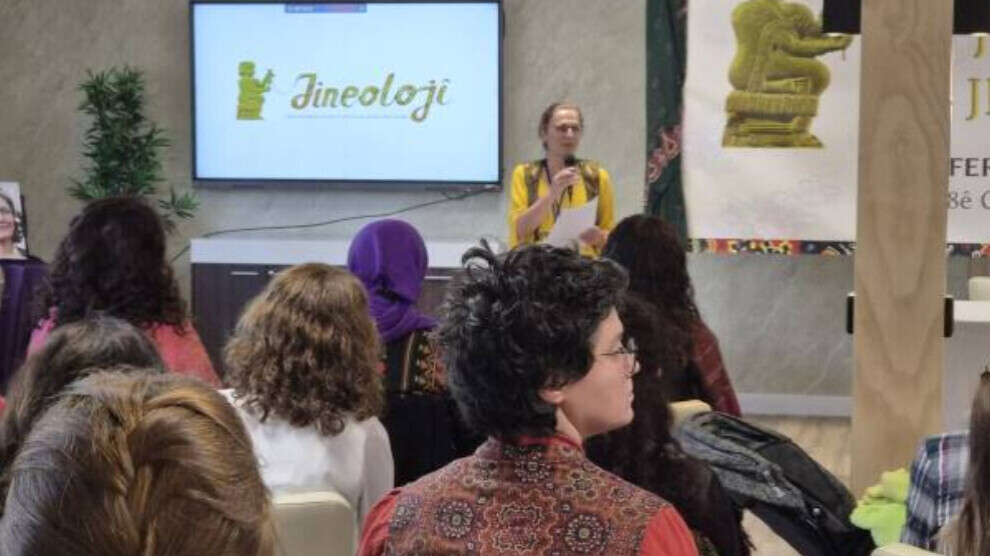
NEWS CENTER – The spokesperson for the Jineology Academy, Alef Kaya, confirmed that the Women's Science Conference represents a historic step to reassess women's struggle extending for ten years in Europe, and to formulate a new cognitive and social vision that meets women's aspirations toward liberation and equality.
The activities of the Jineology Conference in Europe launched in the Dutch city of Herleen today, Friday, 16 October, with the participation of more than 100 delegates from Switzerland, Germany, France, the Netherlands, Belgium, the United Kingdom, Ireland, Spain, and Italy. Over three days, the conference will review, under the slogan "Building a Communal and Free Life Through Jineology."
The conference focuses on evaluating the cognitive legacy achieved during the past ten years in women's studies, and examining mechanisms for employing this science in the future organizational and social structure.
In the opening speech of the conference, academic member Alef Kaya confirmed that this event represents a historic moment to evaluate the journey of 18 years of the development of women's science (Jineology), stressing that the concept that was first proposed in 2008 has turned into a comprehensive study for women from different peoples.
She recalled the sacrifices of the late pioneers, stressing the need to address the gaps of the past to formulate future goals that meet society's aspirations for freedom and equality.
Alef Kaya reviewed the level of expansion achieved by Jineology studies in Europe, explaining that it has become structurally organized in 7 countries, which paves the way for new horizons in other countries. She shed light on the pivotal role of the late pioneers who left a great struggle legacy from which this science drew its foundations and cognitive essence, specifically mentioning the martyrs: Sakine Cansiz, Leyla Akreyi, Nakihan Akarsal, Malda Kosa, Ararat Bawer, Helin Murad, Eysan Armanch, Alina Sanchez, and Helin Karakocx (Anna Campbell).
In a symbolic gesture, she pointed to the empty chair in the conference hall, confirming that the ideas of these pioneers and their struggles filled with courage and hope still constitute the compass guiding the journey of women's science and its institutional development.
Alef Kaya expressed the meaning that the pioneering women added to women's science. "They are the pioneering women who connect us to our self-knowledge and deepen our search for answers to questions about our identity. They are the ones who give women's science its spirit. In this sense, Jineology is also related to the close connection with the past and to understanding and awareness."
"We Will Set Our New Perspective for Work in the Coming Period"
Regarding the shortcomings in the studies, she said that they were not sufficient to develop the ability of every woman to work in an environment that enables her to see herself, deepen her research, and find answers to her questions. "We aim through this conference to reveal our shortcomings, and to innovate a new perspective and transcend them together, in a way that serves the new era."
Alef Kaya noted that the conference aims to determine the organizational model and new work methodology for the coming period, stressing the importance of the discussions that will be held in the workshops. "The preparation process took place with broad participation and contributions from various fields of work, as extensive discussions were held during which criticisms, opinions, and suggestions were presented with each of: women's councils, the committee for building the social field, the press, the Democratic Sociology Association, the Academy of Social Sciences, women's confederal studies, the foreign relations sector, and democratic alliances. Many comrades participated in the preparation work with great interest and bore the responsibility for implementing it and made diligent efforts, and therefore the workshops came out with extremely important results."
"Training and Research Activities Must Be Strengthened"
The Kurdistan Women's Freedom Party (PAJK) addressed a message to the conference in which it reviewed the journey of 11 years of research, defining the responsibilities of the next phase.
The Party confirmed in its message that this science should not be limited to one committee, but should be generalized as a sociological approach in all institutions of the feminist movement to achieve social and political change. It stressed the necessity of coordination, joint planning, and precise distribution of roles between specialized institutions, to ensure the integration of efforts and avoid overlapping responsibilities.
The message noted that despite the great international influence achieved by women's science in Europe, the failure to sufficiently strengthen relations with Kurdish and Middle Eastern women is considered a fundamental shortcoming. "We are in a position of self-criticism regarding reaching the social fabric of Kurdistan and the Middle East and influencing it."
The message shed light on the changing social reality of the Kurdish community residing in Europe, stressing the necessity of transcending work merely supporting the struggle inside the country. It emphasized the importance of organizing women's science "Jineology" itself on its social foundations, and developing solutions to the problems facing women and society.
The PAJK Party stressed the necessity that training, research, and camps activities conducted within the framework of women's science strengthen social organization. "When determining how to organize and plan women's science studies, the most important task should be protecting and strengthening social organization."
It also warned in its message against distorting the concept of women's science by separating it from its historical roots, confirming that women's science is based on the struggle experience of the Kurdish women's liberation movement. It called for exchanging this experience and developing it from a strategic perspective.