
Efforts to Restore Kurdish Names to Villages Turkified in the Kurdistan Region
Kurdistan Civil society & activists in the Kurdistan have launched a campaign to document, reinstate the original Kurdish names of 140 villages that still bear Turkish names, in a move organizers say aims to preserve identity, geographic naming.
HIVY SALAH
Sulaymaniyah — The battle over identity in the Kurdistan Region has not been confined to land or politics; it has extended to geography itself. Over past decades, changing the names of cities, towns, and villages became one of the most prominent methods used to reshape collective memory and erase the historical identity of a place.
Researchers and heritage activists believe that these naming-change policies were not merely administrative measures, but part of political projects aimed at redrawing the demographic and cultural landscape of the region.
Researchers point out that the roots of this policy go back to the Ottoman era, when the names of villages and areas were recorded in Ottoman Turkish within the state's administrative system. In later periods, particularly under successive Iraqi regimes, a number of those names continued to be used, while new names were also imposed as part of Arabization and demographic-change policies — a process that specialists say weakened the connection between residents and the historical names of their areas.
The renaming affected hundreds of villages in Kirkuk, Garmian, Tuz Khurmatu, Kifri, Khanaqin, the Nineveh Plain, and parts of Duhok and Erbil. Historians believe that many of the Turkish names used were either translations of the original Kurdish names or names linked to Ottoman-era clans or figures, before they became, over time, official designations on maps and in government documents.
Historical specialists emphasize that a geographic name is not merely a label for a place, but stands as a historical document reflecting a community's identity and its continuity on its land. For this reason, changing the names of villages and towns is viewed not simply as an administrative act, but as an infringement on the historical memory and cultural identity of the place.
A Civil Movement to Correct Geographic Identity
In this context, civil society organizations, historians, and heritage activists launched a broad campaign in recent months to reinstate the original Kurdish names of villages whose names changed over the decades.
The campaign operates on two main tracks. The first is community-based, documenting the original names through the testimonies of elders, old manuscripts, historical maps, and locally inherited oral accounts. The second is legal and administrative, involving the submission of official memoranda to local administrations and provincial councils demanding that historical names be reinstated on maps, in official documents, and on signage.
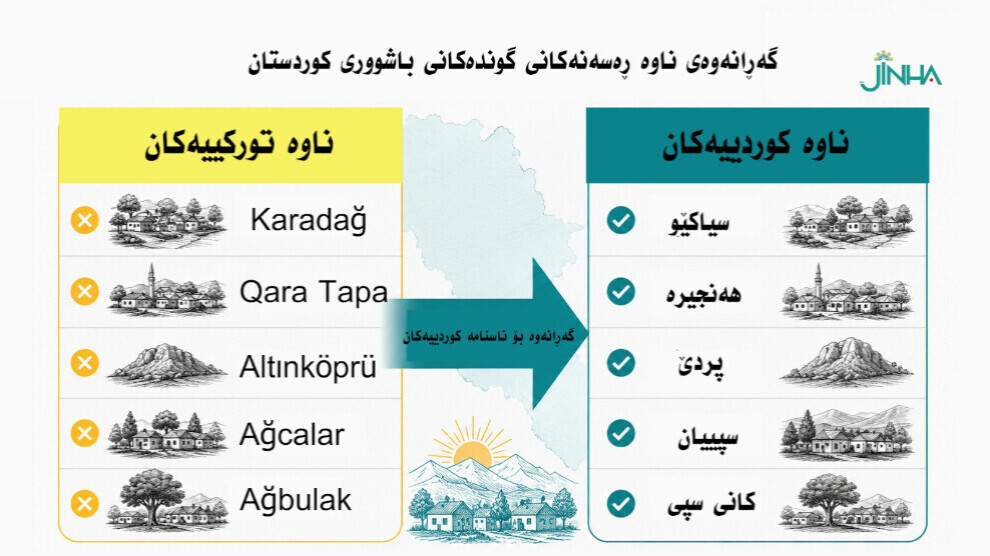
Campaign organizers say more than 140 villages in the Kurdistan Region still carry Turkish names, and they are calling for these to be restored to their original Kurdish forms. Among the notable examples cited by the campaign: Altun Kupri, proposed to be renamed "Perdê"; Qara Hanjir to "Hanjira"; Qara Tepe to "Kurdê Reş"; Qara Dagh to "Siyakoy"; Bash Bulagh to "Sarkanî"; Agh Bulagh to "Kanî Sipî"; and Sari Bulagh to "Kanî Zerd" — alongside dozens of other villages whose names carry Turkish suffixes such as "tepe," "bulagh," "koy," and "qara."
Campaign organizers argue that these imposed names remain present on official maps and in daily use, even though the majority of residents in these villages speak Kurdish and often use the historical names within their local communities.
Despite the popular momentum the initiative has gained, it faces complex legal and political challenges. Officially renaming villages requires amendments to property records, government documents, and official maps, in addition to coordination between the Kurdistan Regional Government and the Iraqi federal government. The campaign also faces objections from certain political quarters, who view it as an issue with political dimensions, while its organizers insist their goal is limited to correcting historical names and restoring the original geographic identity.
Among the other challenges is that many of these names have been in circulation for over a century, causing entire generations to grow accustomed to using them — which requires long-term documentation and awareness efforts.
Researchers stress that preserving original geographic names is an essential part of protecting intangible heritage, as such names form a historical record reflecting the succession of civilizations and the settlement of communities in their places. With this in mind, campaign activists continue to gather historical documents, old maps, and oral testimonies to build scientific and legal files supporting their demands.
Campaign organizers emphasize that restoring the original Kurdish names is not, in their view, merely a linguistic or cultural correction, but a step toward preserving historical memory and safeguarding the geographic identity of the Kurdistan Region — ensuring its transfer to future generations as part of the region's historical and cultural legacy.