
Despite the Dominance of Digital Media... "Ronahi" Newspaper Distributors Carry the Printed Word to Readers
At a time when print journalism is retreating before the digital tide, "Ronahi" newspaper continues to make its way to readers thanks to the efforts of distributors who believe in the importance of the printed word.
SURKIL SHEIKHO
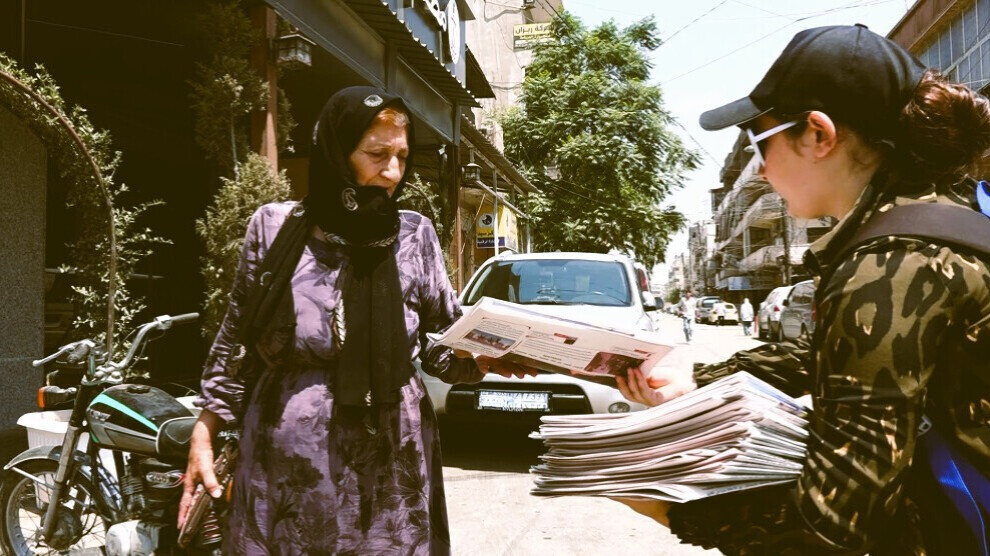
Qamishlo — Despite the dominance of digital platforms and the decline in demand for print newspapers, there are still hands carrying the newspaper from street to street, believing that the printed word leaves an enduring impact. Among these hands, Dilber and Amina Abbas recount how distributing "Ronahi" newspaper changed their lives, shaping their personalities and expanding their social circles.
In light of technological development and the shift of most media to digital platforms, the distribution of print newspapers has declined in favor of apps, news websites, and electronic newsletters. Demand for buying books and reading newspapers has also decreased as a result of economic crises, wars, and social conditions, negatively impacting reading culture.
Despite the circumstances and challenges, "Ronahi" newspaper has maintained regular publication since its founding in 2011 in Rojava, as a political, social, and cultural newspaper published by the Ronahi Distribution Foundation. It continues to issue editions in both Kurdish and Arabic, with 2,688 copies distributed monthly—evenly split between the two languages—reaching readers through distribution twice a week in Rojava's cities, reflecting the continuity of its media message and the expansion of its presence.
A group of distributors, including women, undertake the delivery of the newspaper to readers. Distributors Dilber and Amina Abbas share their experiences with this work.
From Shyness to Self-Confidence
Dilber Abbas began distributing "Ronahi" newspaper at the age of nineteen and is now twenty-seven. She says her beginnings were full of shyness because she had never undertaken a similar experience. She hesitated to hand the newspaper to people—whether doctors, lawyers, shop owners, or the elderly—for fear they would refuse the newspaper or belittle her as a woman.
However, she affirms that these fears faded over time, and she managed to overcome her shyness and continue her work to this day.
Building New Social Relationships
She explains that Kurdish women were among the first to experience newspaper distribution in the region, considering this step important and contributing to strengthening her personality and expanding her circle of acquaintances, through which she met many people and established new social and human relationships.
She notes that readers ask about the newspaper when it is late for distribution, reflecting their connection to it.
The Elderly Are Most Keen on the Newspaper
Dilber Abbas says that the group most eager to read the print newspaper is the elderly, as many do not rely on smartphones, while young people tend to follow news online and through social media for quick information. Nevertheless, she affirms that the print newspaper has its own special place, despite the importance of digital media.
Dilber Abbas distributes about 100 copies every Sunday and Wednesday in markets, offices, restaurants, and streets of Qamishlo, despite the summer heat.
"Print Newspapers Are Still in Demand"
Amina Abbas (36 years old), a third-year student in the Arabic Literature Department, has been distributing the newspaper for five years. She says society's view is divided—some are proud of women working in newspaper distribution and support them, while others still look down on this work.
She adds that she and her colleagues, through their persistence, managed to change part of this perception, and the number of copies they distribute has increased due to rising demand, especially among young people and passersby on the streets.
She also notes that the print newspaper represents an important source of information for people who do not have televisions or smartphones, as they receive various news and information through it.
She affirmed that reading a print newspaper is more comfortable and healthier for the eyes than reading PDF files on a phone, as the font in electronic versions is small, and prolonged phone use may cause eye strain and various health problems.