
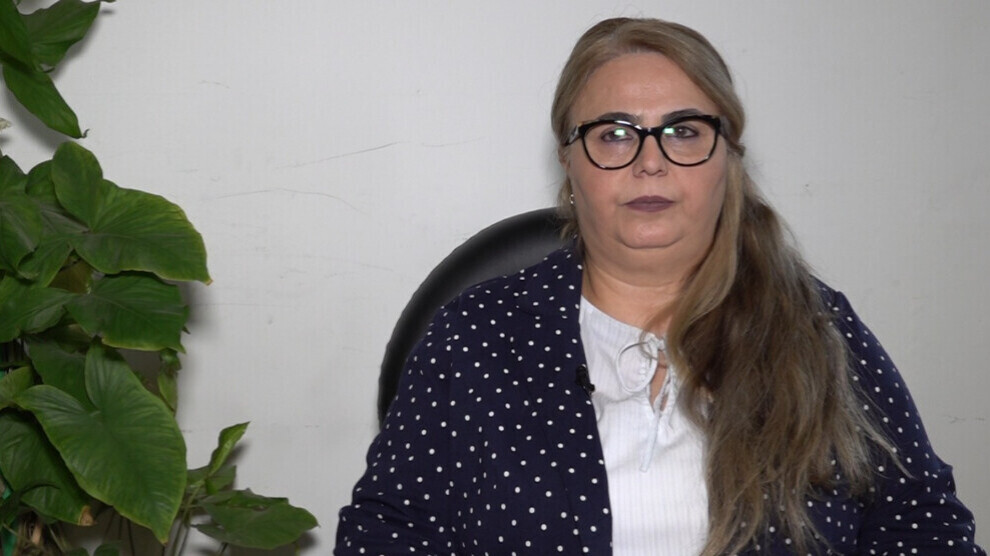
Parşîn Muhammedi: Women of Eastern Kurdistan Will Have a Prominent Role in the Future of the Country
Violence against women persists in the Middle East as a pervasive and intractable phenomenon. In Eastern Kurdistan, the state's practices constitute political violence against women, driven by a male-dominated mentality used to control society.
Helen Ahmed
Sulaymaniyah — With every political crisis it goes through, the Islamic Republic of Iran intensifies its violence against women. This is what happened after the Jina Amini revolution and after the war that broke out with America and Israel, as arrests increased and prison conditions worsened. Women face, in addition to psychological and physical violence, sexual assault, as well as execution without any international human rights monitoring.
In order to put an end to this reality and end violence and injustice, the women of Iran and Eastern Kurdistan need to unite and make greater efforts so that women can have a role in the next phase, which will constitute an important achievement for women and society.
Parşîn Muhammedi, a member of the Central Committee of the Kurdistan Workers' Party, emphasized that the next phase requires separating religion from the state and implementing secularism, given that the Iranian regime commits physical and psychological violence against women in the name of religion. "Violence against women is a global issue. Despite the struggle of political and independent organizations in Eastern Kurdistan, violence against women by the ruling regime and the patriarchal system continues, despite the high level of awareness and culture in Eastern Kurdistan."
She explained that in addition to societal violence against women and domestic violence, women face violence from the authorities. "Raising women's voices against the Iranian regime leads to their imprisonment and execution. This violence against women is deeply rooted over time and requires women's struggle and unity to eliminate it."
"Women Are Executed Simply for Demanding Their Rights"
She stated that women face violence inside prisons. "Physical violence against women in Iran and Eastern Kurdistan has increased since the Jina Amini revolution. Many human rights activists and defenders of women's rights are detained in Iranian prisons or sentenced to death, and many of them face physical, psychological, and sexual violence."
She pointed out that in December 2025, the Iranian regime committed what she described as a "major catastrophe against citizens," saying, "The regime killed civilians in Iran and Eastern Kurdistan, and many were arrested, executed, and their bodies sent back to their families."
She added, "More than 50,000 innocent civilians were killed. Despite the killings and imprisonment of citizens, the international community and human rights organizations choose to remain silent about Iranian dictatorship because this dictatorship causes problems for any country that opposes it. Therefore, women must confront violence through cultural and social awareness, and we must work to remove the impact of outdated culture and distorted religion on women's rights."
She affirmed that "in the Middle East, women are influenced by culture and religion, so secularism and the separation of religion and state must be applied. In the future of the Middle East, women's issues must be different from what they were in the past. Women must have status and authority in decision-making in the new state."
"Women Will Have a Voice in the Coalition"
Parşîn Muhammedi views the future of women in Iran and Eastern Kurdistan with optimism, as a result of the unity achieved among Kurdish parties. "The unity of Kurdish political parties has had a profound impact. Eastern Kurdistan has always needed unity to confront the oppression of the Iranian regime. This year, a coalition was formed between political parties, and women will have a prominent voice and presence in it." She stressed that "women will fulfill their role in this coalition through their parties. We will all work together in coalitions and joint efforts to improve the situation of women in Eastern Kurdistan."