
Calls to Abolish the Death Penalty in Iran at Paris Conference
Conference participants urge the world to prioritize Iran’s executions and human rights, demanding pressure on the regime and support for prisoners facing death.
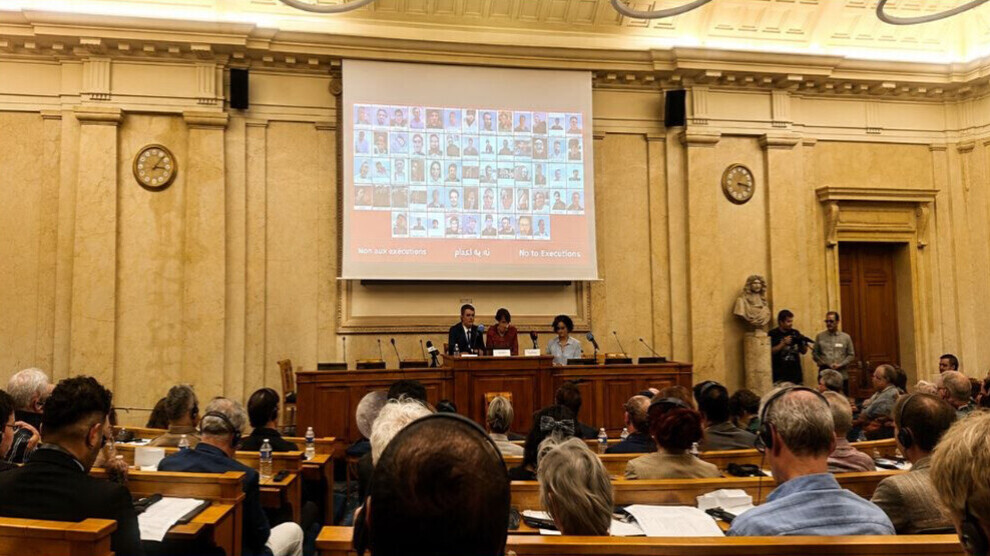
Paris_Executions in Iran constitute a highly controversial international file, with human rights reports increasingly documenting their use against political opponents and defendants charged with various crimes, amid ongoing international calls to halt them and strengthen justice.
The Colbert Hall at the French National Assembly hosted a conference yesterday, Monday, June 29, titled "Opposing the Death Penalty in Iran." The meeting was organized in collaboration with the French-Iranian Friendship Group at the French National Assembly and the "Iran Freedom Conference," and was attended by a number of French politicians, human rights activists, cultural figures, and representatives of political movements opposed to the Islamic Republic.
The Executive Director of the Iran Freedom Conference emphasized the importance of defending the right to life, considering that combating the death penalty is a responsibility that transcends geographical borders. He affirmed that every death sentence, in addition to extinguishing a human life, strikes a blow to human conscience and the universal values of human rights.
One of the conference's main highlights was the announcement that 200 French parliamentarians had adopted a political bail release for 200 prisoners in Iran who have been sentenced to death or face the risk of execution. The organizers considered this initiative a symbol of solidarity with political prisoners and a means to draw the attention of public opinion and international institutions to the human rights situation in Iran.
Aida Hadizadeh, President of the French-Iranian Friendship Group at the French National Assembly, stressed the need to unify efforts opposing the Islamic Republic and to use international capacities to amplify the voices of Iranian protesters.
Regarding the widespread arrests of civil and political activists in Iran, she said that the fate of political prisoners should not be ignored in light of regional developments and political negotiations, and that the international community should use all its tools to protect their lives.
Fariba Borhanzehi, one of the speakers at the meeting, reaffirmed the accelerating pace of executions in Iran, accusing the Islamic Republic of using the death penalty as a tool to suppress protests and civil activities.
Speaking about Sistan and Baluchistan province, she pointed out that the proportion of Baloch citizens among those executed far exceeds their demographic ratio, considering this evidence of structural discrimination practiced against this group. She criticized the international community's silence and inaction, which she said contributes to the continuation of this approach.
"Execution Is a Tool to Entrench Despotism"
Nahid Bahmani represented the Kurdish parties at the conference. In her speech, she reviewed four decades of executions and repression in Iran, affirming that the death penalty constitutes a fundamental pillar in the survival of the Islamic Republic.
Speaking about the executions carried out in the early years after the 1979 revolution and the continuation of repression in East Kurdistan, Iran, she stressed that the Islamic Republic's execution machine has not stopped for decades but has been continuously used to instill fear and consolidate control over society. She affirmed that the government's primary concern is popular protests, not foreign military pressure.
War Is Not the Path to Iran's Freedom
The former French President also affirmed at the conference that war cannot be the solution for the Iranian people to achieve freedom, pointing out that the experience of past years has shown that military conflicts have not only failed to bring about democratic changes but have also provided opportunities to strengthen the Islamic Republic.
While expressing concern about the potential decline of international pressure on the Islamic Republic, he stressed that the international community must not ignore the human rights issue and executions, noting that if he were in the executive branch, he would not agree to the easing or lifting of sanctions imposed on the Islamic Republic. He believes that political and economic pressure must continue until the government's behavior changes.
Freedom Cannot Be Built on the Ruins of War
Sipideh Farsi, a filmmaker and cultural activist, delivered an intervention in which she strongly rejected any foreign military intervention in Iran, affirming that freedom and democracy cannot be won through war and destruction.
She explained that the Iranian people first and foremost need moral and political support from the international community, pointing out that priority should be focused on halting executions, ending impunity for human rights violators, and strengthening civil movements within the country.
Part of the meeting was dedicated to the narratives of families of plaintiffs and survivors of execution victims—a segment that depicted the human consequences of the death penalty and government repression through the expression of personal experiences.
A video message was broadcast from the mother of the martyr Ramin Hossein Panahi, in both Kurdish and English, in which she recounted the details of her son's execution, affirming that despite many years having passed, the family remains deprived of the right to receive Ramin's body. She noted that this deprivation has compounded the family's suffering and prevented them from completing their mourning and closing a wound that has not healed.
In a related context, the representative of the Democratic Solidarity Party in Ahvaz, speaking about secret executions in Khuzestan, called on the international community to abandon the policy of dialogue and appeasement with the Islamic Republic.
A member of the Aban Family Lawyers Association criticized the international community's indifference to internal repression in Iran, stating that the Islamic Republic has always exploited war and external tensions to intensify repression. He affirmed that peace does not only mean ending war, and that as long as executions, lawyers, and victims of human rights violations are ignored, lasting peace will not be achieved.
Participants in the meeting stressed the need for continued international support for prisoners sentenced to death, intensified pressure on the Islamic Republic regarding human rights, and keeping the human rights issue at the forefront of international institutions' concerns. They called for the fate of prisoners and their families seeking justice not to be affected by political developments and diplomatic negotiations.
Participants also reaffirmed their commitment to te slogan “No to execution, no to state-committed murders,” pointing out that defending the rights to life is a global responsibility, and that transforming opposition to the death penalty into a permanent international demand is a necessity that cannot be ignored.