
A panel discussion sheds light on the reality of women in Rojava
Amid the escalating political and social crises in the region, cultural and intellectual activities continue in order to highlight the issue of women in Rojava and the challenges they face.
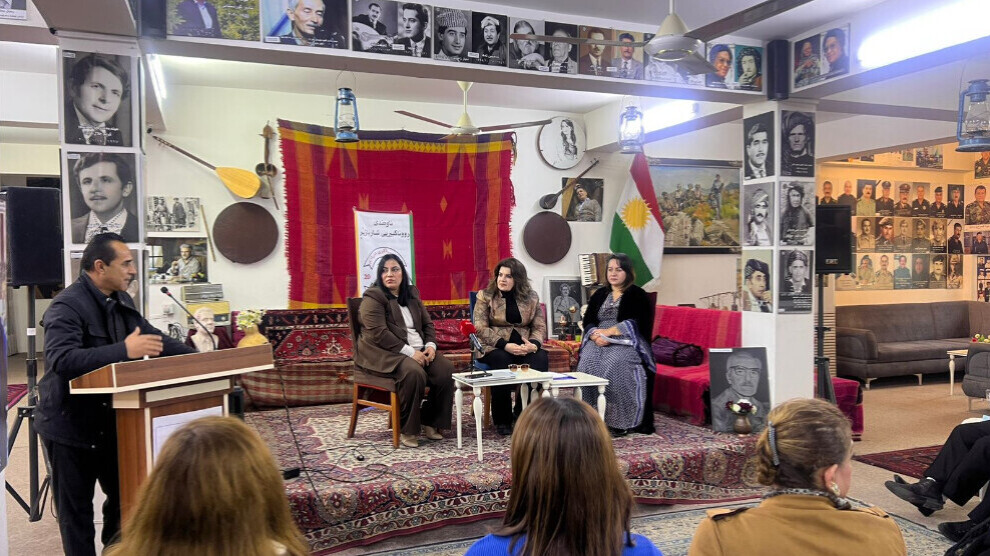
Sulaymaniyah – Participants in a panel discussion affirmed that speaking about the conditions of women in Rojava is essentially speaking about rights, existence, and human dignity, because the women’s issue is a central one in all parts of Kurdistan.
A panel discussion was held at the Sara Cultural Center in the city of Sulaymaniyah, in cooperation with the Shar Bazher Enlightenment Center, on Sunday, February 15. It was attended by a number of activists, women’s rights advocates, and intellectuals. The discussion addressed the reality of women in Rojava, their role in the Autonomous Administration, their experience in various political and social fields, and their position within the laws and the new Syrian constitution.
“Women have an active role”
Saza Abdullah, a professor and activist in women’s issues, pointed out that Kurdish women in Rojava have become known worldwide as revolutionaries.
“Women have an influential role in confronting the enemy, especially under difficult political conditions.”
She explained that women in different parts of Kurdistan had a prominent presence in demonstrations supporting Rojava, where they raised their voices and called for Kurdish unity.
She also noted that through solidarity with their families, women provided mutual support. She referred to Deniz Jiya, who was martyred during the resistance in Sheikh Maqsoud neighborhood, as a great example of sacrifice. She lost her life, but women around the world raised the banner of her cause, turning her into a symbol that moved the global conscience. She stressed that women in the Middle East hold a special position, and although women worldwide have faced wars, Kurdish women are struggling for their rights.
Major achievements facing ongoing challenges
For her part, the lawyer Jîman Omar stated that the political system in Rojava is based on the principle of joint leadership between women and men, giving women equal decision-making power in public issues.
She pointed out that the participation of all components in Rojava exceeds the limited quotas applied in Iraq and the Kurdistan Region, where women are granted 30%, while in Rojava women’s participation in decision-making reaches 50%, ensuring full gender equality.
She also explained that women’s courts in Rojava operate peacefully in favor of women through a female judiciary that addresses the social problems they face. In addition, economic projects aim to empower women financially so they can secure an independent income. Women also play a role in the ecological economy that links environmental protection with women, as women are considered the guardians of nature.
She touched on the role of mothers who lost their children in battles, stressing that they contribute to protecting the land by carrying weapons in the streets and defending society. She noted that the achievements in Rojava are significant, but the region faces continuous crises due to ongoing threats from neighboring states and occupying forces, as well as the lack of international recognition, which has led to wars in the area.
She emphasized that the existence of the Autonomous Administration in Rojava has given women a historic opportunity to take active roles in various sectors. Women have gained a prominent role in political, social, and economic life, but this progress faces major challenges due to continuous attacks from neighboring countries that oppose the model of self-administration, in addition to genocidal campaigns targeting the Kurds in Rojava.
Shida Ma’arouf, a member of the Shar Bazher Enlightenment Center, said that the women’s issue is central in all parts of Kurdistan, where women face multiple forms of violence and threats. She pointed out that the situation in Rojava and Eastern Kurdistan is becoming more dangerous due to security and political tensions, noting that women have taken to the streets in support of the women of Rojava and that such activities should expand to raise public awareness about the seriousness of the situatio