
Journalist Amal Khalil Killed After Two Years of Direct Israeli Threat
Journalist Amal Khalil, who worked for the Al-Akhbar newspaper, was killed in an airstrike that directly targeted her in the town of Al-Tayri in southern Lebanon. This came after she received a direct death threat during the year 2024.
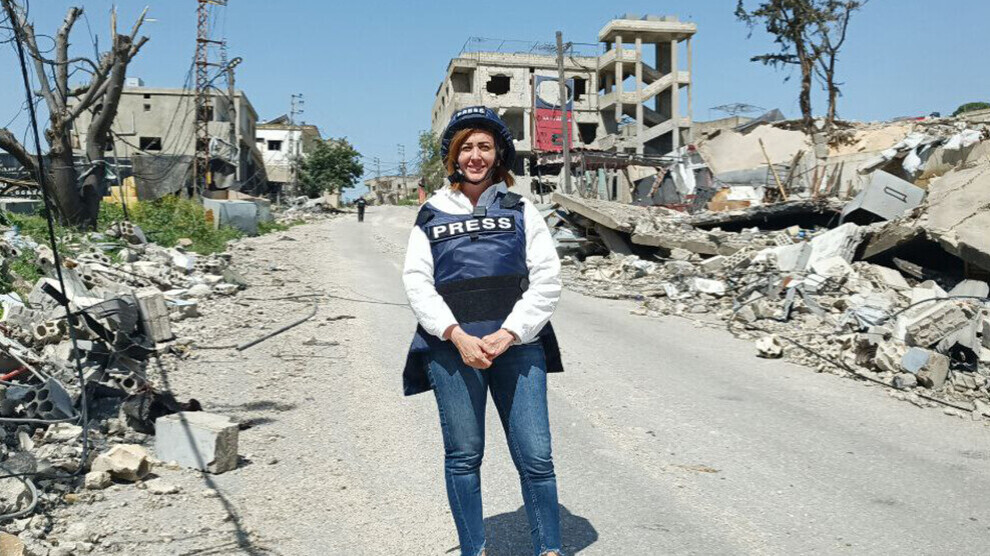
Lebanon_” Amal Khalil Known for her field coverage in southern Lebanon. She continued her work despite the threats she received from Israel, before she became a tragic headline added to the series of targeted attacks against journalists while carrying out their duties.”
Amal Khalil wasn’t just a number to be added to news bulletins, nor a fleeting name in a breaking news ticker. She was a journalist the size og a homeland, a vioce that walked among people, capturing stories from her land and returning them to the world with a sincerity that mirrored her. But on Wedneseday, April 22, that voice turned into the most painful headline.
Israel, with premeditation and deliberate targeting, killed journalist and correspondent Amal Khalil of Al-Akhbar newspaper in an Israeli airstrike that directly targeted her in the town of Al-Tayri in southern Lebanon. According to field reports,journalist Zainab Faraj was also wounded in the strike and was transferred to Tabnin Governmental Hospital, where she underwent surgery on her head and leg.
"The scene did not stop at the targeting of journalists. After Zeinab Faraj was rushed to hospital, warplanes launched a new strike to push back ambulance and rescue teams. Later, these teams, along with the Lebanese army and civil defense, were prevented from reaching the bombing site for seven consecutive hours, which prevented Amal Khalil from being rescued in time and left her trapped under the rubble, waiting for death.
Amal Khalil, known as the 'Southern Correspondent' for Al-Akhbar newspaper, was not just a journalist covering events. She was part of their fabric. For over twenty years, she wrote about the south and its daily life in all its complexity — from politics to economics, from the environment to health, including farmers' issues, tobacco, the Litani River, quarries and crushers, elections, the sea in Tyre, the markets in Sidon, Nabatieh, Bint Jbeil, Marjayoun, Hasbaya, and Jezzine. She conveyed the pulse of the land, with all its fatigue, hardship, and hope. She knew how to write about people and how to love them. She never carried a weapon — only the word — and she asked for nothing more than that what was happening be seen as it is.
Amal Khalil had previously received a direct threat from Israel during 2024, in which she was threatened that her head would be cut off from her shoulders. Despite that, she continued her field work, moving between villages, driving her car with passion and determination, writing about the south as it is: alive, wounded, and resisting.
Today, Amal Khalil is added to a long list of journalists who have paid with their lives for the truth, falling one after another as the circle of absence widens, leaving the question open: who is next? With her departure, southern Lebanon does not lose just a correspondent; it loses one of its own stories, a voice that resembled it and its people.
The journalist Amal Khalil gave many interviews to our agency, in which she consistently emphasized her duty to continue her work despite all risks. She once said: 'Some colleagues rush to cover wars, security incidents, and natural disasters outside Lebanon for what that adds to their professional record — I consider that a double standard. The war on my land deserves my greatest attention, because it is my cause.'
She also said: 'My presence on the front lines to cover the war does not mean I deliberately expose myself to danger. I adhere to safety standards and the instructions of security officials on the ground. Risking our lives by violating instructions is not heroism. Professionalism and being professional require that I stay safe and sound so that I can continue to do my duty and convey the correct news.'
Previously, Israel had sent her a direct threat via WhatsApp, which read: 'We will separate your head from your shoulders if you do not leave Lebanon.' But she confirmed to our agency that she would continue her journey to uncover the truth despite the threats: 'I know that I may be targeted. The threat message will not intimidate me, just as the enemy did not intimidate me when they killed my colleagues.'"