
Syrian Women’s Council launches empowerment initiatives in shelters in Sweida
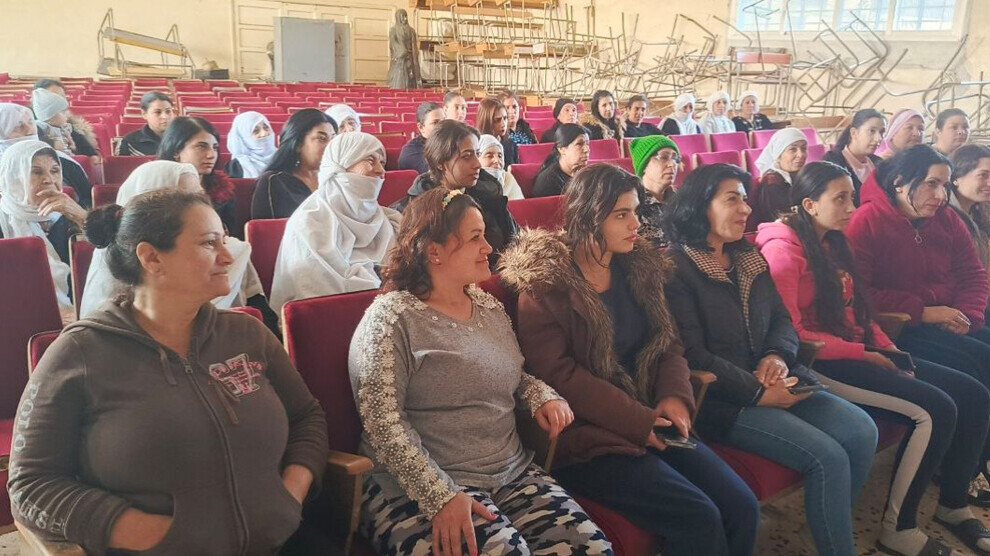
The Syrian Women’s Council launched field visits to the shelters in Sweida as part of Women’s Day interactive week activities, aiming to assess displaced women’s situation and needs amid very difficult humanitarian and economic conditions.
Rosheil Junior
As-Sweida _ Participants in the interactive week activities for Women’s Day unanimously agreed on the importance of these training initiatives, considering them a real opportunity to enhance their ability to achieve income independently, while also helping them improve their psychological state by breaking isolation and building a mutual support network within sheltres.
The Syrian women’s Council, as part of the interactive week activities for Women’s Day and enhancing their active role in society, organized a series of field visits to shelters in the city of Sweida. These visits aimed to directly observe the conditions of women residing there and identify their most prominent needs and challenges in light of the difficult humanitarian and economic circumstances.
This step came as part of ongoing efforts to support and empower women, especially in the most fragile environments, where women bear double burdens due to displacement, loss of income sources, and instability.
The results of these visits revealed an urgent need for practical programs that enhance women's economic independence, prompting the Council to launch a set of initiatives, including providing free vocational training courses focused on skills needed in the local labor market, giving women a real opportunity to start small projects or integrate into new fields of work.
"The beginning of a series of programs"
Asala Aslan indicated that these courses represent the beginning of a series of training programs that the Council will work to generalize across various shelters, pointing out that the future plan includes introducing diverse training fields, along with continuing to organize awareness workshops and psychological support sessions, aiming to help women overcome the psychological and social effects left by the crisis.
"Expanding the scope of training"
For her part, trainer Sham Aslan explained that the course lasts between 10 to 15 days, during which trainees are divided into small groups to ensure training quality and achieve the desired benefit. She affirmed that the goal is not limited to teaching a temporary skill but reaching full empowerment, so that participants become capable of practicing the profession independently and entering the labor market with confidence. She noted the possibility of expanding the scope of training in the future to include other fields if there is demand from trainees.
"A precious opportunity"
In turn, beneficiary Alhan Amer affirmed the importance of these initiatives, pointing out that free courses represent a precious opportunity under current economic conditions, where it is difficult for many women to afford training costs. "These activities are not limited to the professional aspect but also contribute to improving psychological state by breaking isolation, alleviating feelings of sadness resulting from displacement and loss of homes, in addition to creating space for communication and solidarity among women."
"Achieving self-sufficiency"
In the same context, trainer Najoud Abu Assaf, a specialist in handicrafts, affirmed the continuation of training women in shelters on productive skills such as beadwork and weaving on looms, pointing out that these crafts contribute to achieving self-sufficiency and providing a source of income, especially given limited job opportunities.
She revealed plans to launch an integrated training program during the summer of 2026, with support from cultural institutions, aimed at developing the skills of both women and men in various craft fields.
She stressed that women's empowerment is not limited to the economic aspect alone but extends to the psychological and social aspects, as engaging in work and production helps reduce stress and depression, enhances feelings of achievement and belonging, and strengthens relationships among women through collective work.
These initiatives reflect a clear state of community solidarity, especially from the women of Sweida, who continue to support one another in facing challenges by providing training and work opportunities and organizing community initiatives.
Amid these efforts, women's empowerment emerges as one of the fundamental pillars of the recovery process and societal rebuilding, ensuring a more stable and just future, affirming that investing in women's capabilities is a real investment in the advancement of the entire society.