
The narrative of military objectives hides the biggest loser, and the Iranian people are paying the price of war.
In the ongoing conflict in Iran,power shifts to military and security apparatuses as suffering spreasss across society_ a transformation reflecting the logic of a war economy.
Shilan Saqzi
Special Report – The narrative of “purely military objectives” in the current US‑Israeli war against Iran is nothing but a cover hiding the fact that the biggest loser is the people themselves. In the logic of political economy, war is not confined to front lines or military targets; rather, it extends like a raging wave sweeping across various aspects of social life.
In a system like Iran, these costs are systematically transferred to the lowest strata of society, while power groups maintain their ability to reproduce their influence through monopolizing resources. Thus, war is not limited to destruction; it also organizes a “transfer of suffering,” whereby society becomes the primary arena for paying the price of the conflict.
At the heart of this war, a radical transformation occurs: resources, decision‑making, and power become concentrated in the hands of military and security institutions, while suffering spreads and intensifies throughout society. This process is part of the internal logic of a “war economy.”
Under such conditions, institutions like the Islamic Revolutionary Guard Corps (IRGC) become not just security entities but also key economic players, enjoying privileged access to strategic resources including oil. In contrast, the state, as a provider of public services, aligns itself with security institutions. What is less visible is how this transformation reflects on people’s daily lives: through cuts in education and health budgets, deteriorating public services, and rising living costs. In other words, the more power concentrates at the top, the broader and deeper the pressure on the base becomes.
Contrary to the idea of sudden collapse, what is happening is a form of “forced endurance”—a situation where society neither collapses nor improves, but gradually erodes. Chronic inflation, currency devaluation, job insecurity, and the collapse of future prospects are signs of a deep transformation in lived experience.
Under these circumstances, war becomes an “accelerator of suffering.” Families face not only rising prices but also a kind of psychological and social instability: fear of the future, forced migration, erosion of trust, and declining social solidarity. In this sense, society is no longer an “economic buffer” but an arena of attrition—an arena where survival becomes a matter of constantly adapting to increasingly difficult conditions.
If we view this war in the context of previous wars, the picture becomes clearer: what is happening is a cumulative process of destruction. Each war destroys a layer of infrastructure, capital, and social trust, and the next war builds upon those ruins.
For the people, this means living in a “permanent crisis”—a crisis with no real opportunity for reconstruction. Even if the war stops, its effects remain present in daily life in the form of debt, inflation, and institutional collapse. As a result, war devours not only the present but also the future—a future that, for many citizens, has become an unknown and distant horizon.
Multilayered Destruction
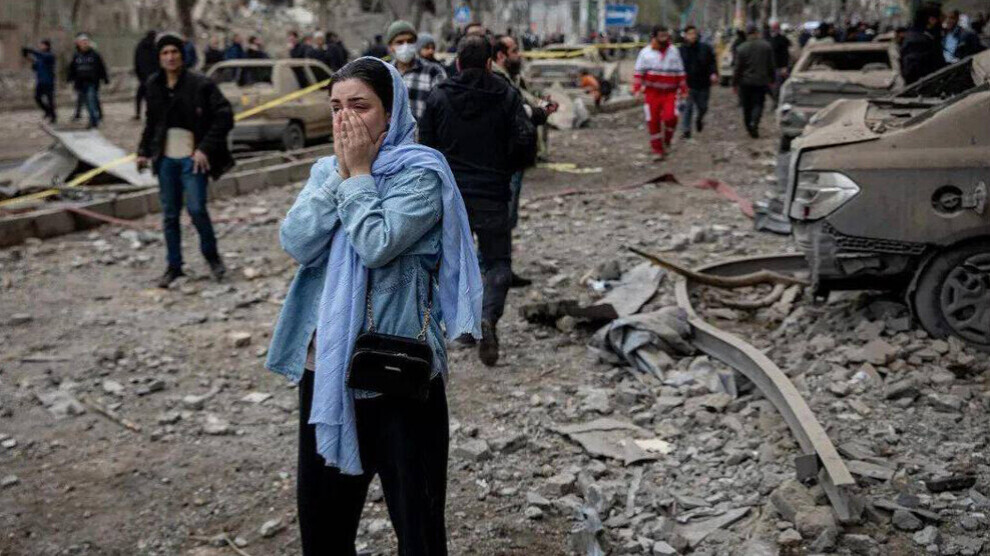
The effects of war‑related destruction directly impact people’s daily lives. Damage to urban infrastructure, disruption of transportation, closure of businesses, and reduced access to services all lead to a decline in quality of life.
Meanwhile, a vicious cycle forms: destruction of infrastructure reduces economic activity and government revenues, which in turn leads to a decline in public services, further increasing pressure on society. Thus, each explosion or military attack unleashes a chain of consequences that ultimately return to impact people’s lives.
Oil is ostensibly presented as a means to compensate for losses, but in reality, the oil economy is dominated by a structure where the bulk of this revenue does not contribute to improving people’s conditions. The costs of sanctions, intermediary networks, corruption, and security priorities mean that only a small fraction of this revenue is allocated to social sectors. As a result, even in a country rich in natural resources, society continues to suffer from a lack of resources needed for basic services.
This paradox—resource abundance alongside social poverty—is one of the main features of a rentier economy in wartime. Likewise, the continuation of war means that costs increase dramatically, but more importantly, it postpones these costs into the future. Rebuilding infrastructure, paying compensation, and financing the war all require resources drawn from the future.
For the people, this means living in an economy that is not only weak but whose future is also threatened. Future generations will pay the price of war, passed on to them in the form of debt, inflation, and diminishing development opportunities.
Inflation
The most significant and visible effect of war on people is inflation—a phenomenon experienced directly and daily. Unlike formal taxes, inflation works silently and on a wide scale, reducing purchasing power, devaluing savings, and exacerbating inequality.
In this process, the people effectively become the main financiers of war costs without having any role in its decisions. Here, war becomes a deeply social issue, revealing the gap between those who make decisions and those who bear the costs.
Under a fragmented and opaque decision‑making structure, the effectiveness of economic policy in its traditional sense diminishes. Decisions are not made according to a coherent plan but result from interaction and competition among various institutions. For the public, this means an unpredictable economic experience, with sudden policy shifts, volatile prices, and a future that cannot be planned for.
In such a situation, the gap between society and the power structure widens—a gap that itself becomes one of the most important consequences of war. What remains in the end is an image of an economy increasingly disconnected from society: an economy suffering from high inflation, limited investment, deteriorating public services, and growing inequality. But more important than economic indicators is the reality of people’s lives.
In this context, the main question is no longer whether the crisis will end, but how much society can endure this situation. Because what is happening today is a continuation of repeated conditions in which people have become the primary losers in an unequal system.